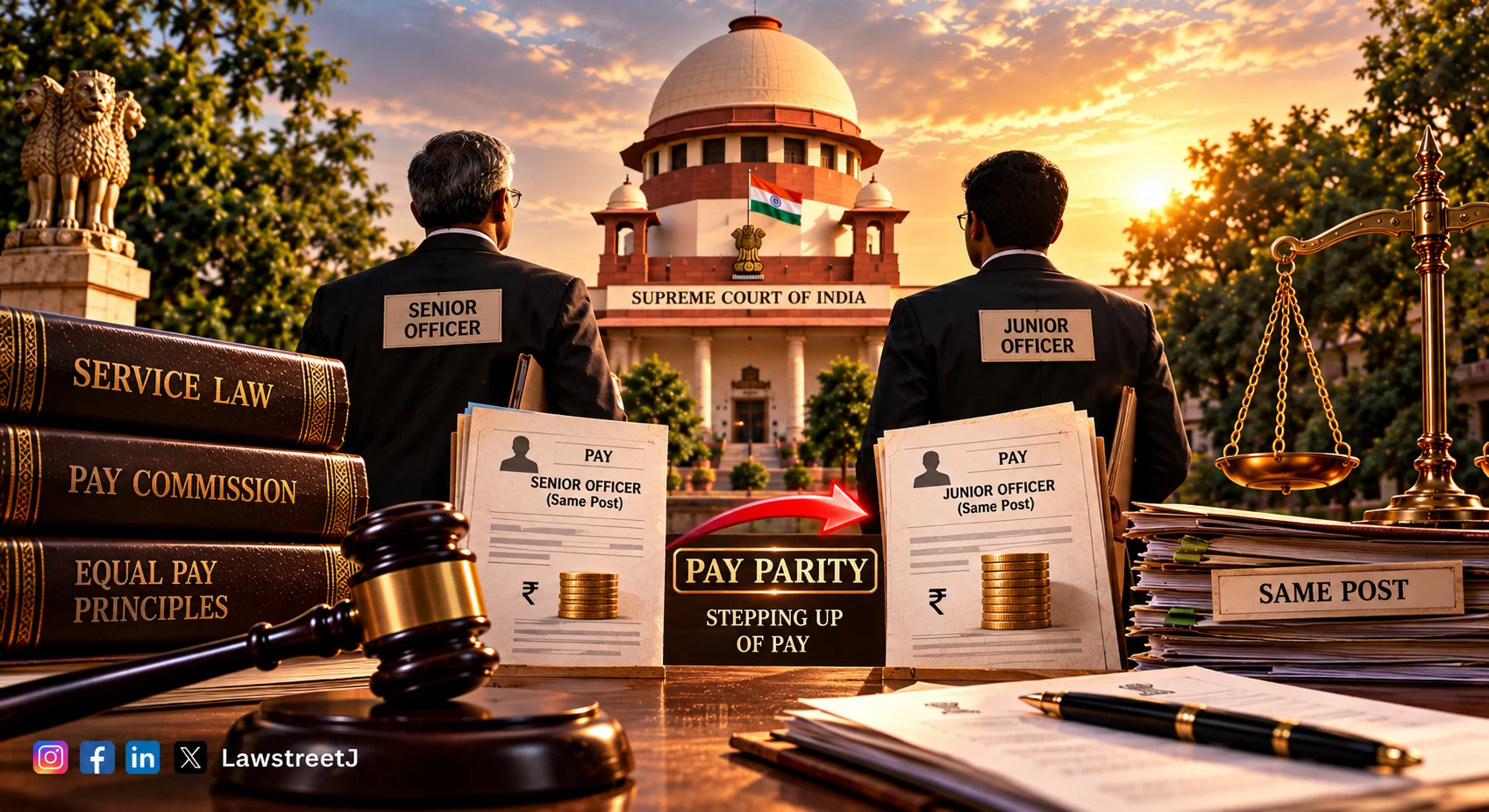
New Delhi: The Supreme Court has set aside an Allahabad High Court order and directed that a college teacher be paid on par with his junior, holding that it is fundamental that a senior officer cannot be paid less than a junior officer holding the same post.
A Bench of Justice Dipankar Datta and Justice Sheel Nagu, allowing Civil Appeal No. 4559 of 2026 filed by Jai Prakash Singh, a Reader in the Department of Education at Dharam Samaj College, Aligarh, against the State of Uttar Pradesh, recorded that the appellant had “been given a raw deal.”
The appellant and one Dr. Pradeep Kumar were appointed as lecturers on the same day in 1990, but the appellant, though senior and the earlier recipient of a Ph.D., ended up drawing lower pay after the High Court granted his junior two advance increments in a separate writ petition. His representations against the resulting anomaly were rejected by the Director of Education, Uttar Pradesh, prompting a fresh writ petition that was dismissed by “a cryptic order dated 08.05.2018.”
Rejecting the State's argument that the appellant had failed to challenge the underlying Government Orders, the Court examined Government Order dated 28.02.2009, which mandates that where a senior teacher's revised pay falls below that of his junior, “the salary of the senior teacher in the revised pay scale shall be made par with the salary of that junior teacher.”
The Court found the High Court's view that this provision did not apply to the appellant to be “an erroneous finding,” noting from the salary chart on record that the appellant was in fact drawing higher pay than his junior even before January 2006.
Holding that the pay anomaly “violates Article 14 of the Constitution of India as well as the provisions in Article 39(d),” the Court observed that no material had been placed on record to justify paying the junior more, since “no demonstrable difference in qualifications for the post, source of recruitment, experience, responsibility and accountability” had been shown.
The Court further held that Government Orders embodying policy decisions “have to yield to the over-arching principles of equality and equal pay for equal work enshrined in the Constitution” to the extent of any inconsistency, and set aside the High Court's order.
Allowing the appeal in terms of the prayer made in the writ petition, the Court directed that the financial benefits be made available to the appellant “as early as possible, but not later than three months from date.”
Appearances: Mr. Sudhir Dixit, Senior Advocate, with Mr. Vishal Prasad, AOR, Ms. Ritika Sethi, Advocate, and Mr. Utkarsh Dixit, Advocate, appeared for the appellant. Ms. Ruchira Goel, AOR, appeared for the respondent/State of Uttar Pradesh.
Case Title: Jai Prakash Singh vs. The State of Uttar Pradesh & Ors.