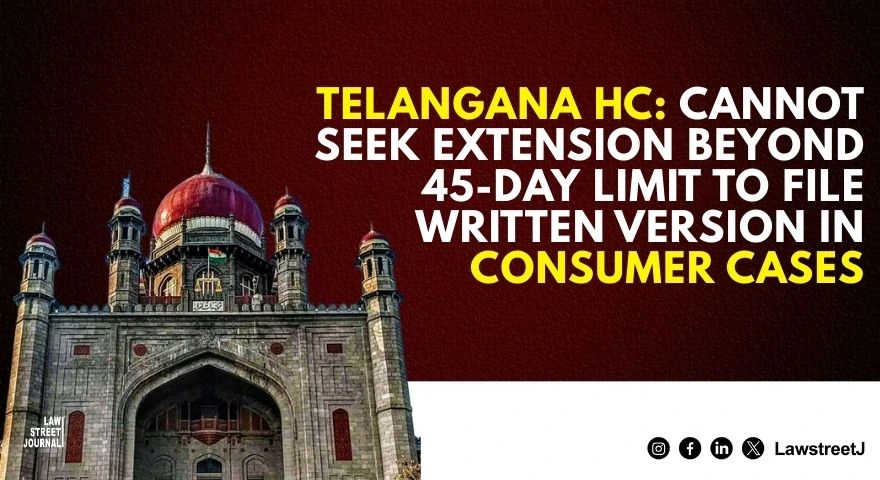
Telangana: The Telangana High Court has ruled that banks and other opposite parties in consumer disputes cannot claim any right to file their written version beyond the mandatory 45-day period prescribed under the Consumer Protection Act, 2019, even by invoking writ jurisdiction.
The Division Bench of Justice Moushumi Bhattacharya and Justice Gadi Praveen Kumar delivered the judgment while dismissing a writ petition filed by Canara Bank challenging orders of the State and District Consumer Disputes Redressal Commissions that had forfeited its right to file a written version due to delay.
The bank argued that the delay was only 42 days and should be condoned, and that it had no alternative remedy since a second revision would not lie before the National Commission. It therefore sought the Court’s intervention under Article 226 of the Constitution to do substantial justice.
The Court rejected these contentions in clear terms. It held that Section 38(3)(a) of the Consumer Protection Act, 2019 provides a maximum period of 30 days plus an additional 15 days (totalling 45 days) for filing a written version, and that this timeline is mandatory and cannot be extended by any consumer forum.
In a detailed analysis, the Court traced the legislative history from Section 13(2)(a) of the Consumer Protection Act, 1986, and relied on the Constitution Bench ruling in New India Assurance Company Limited v. Hilli Multipurpose Cold Storage Private Limited, which held that the 45-day period under the 1986 Act was mandatory. The Court clarified that this binding precedent applies equally to the 2019 Act, which replicates the same provision.
The Court further emphasized that Section 38(5) of the 2019 Act expressly prohibits courts from entertaining proceedings on the ground of breach of natural justice where the District Commission has followed due procedure. This, read with provisions mandating expeditious disposal of complaints within three to five months, demonstrated a clear legislative intent to treat the 45-day limit as final.
On the scope of writ jurisdiction, the Court held that a writ of certiorari cannot be issued merely because a party is aggrieved by an order. Relying on Supreme Court rulings, the Bench explained that certiorari lies only to correct jurisdictional errors, violations of natural justice, or manifest errors apparent on the face of the record, and not to re-appreciate facts or substitute judicial views.
The Court noted that the bank had received notice on May 23, 2025, failed to appear on the first hearing date of June 16, again failed to appear on June 23 after the initial 30-day period had expired, and even failed to appear on July 7, 2025—the 45th day—despite the District Commission having already granted the maximum permissible extension of 15 days. The bank appeared for the first time only on August 19, 2025, when it filed its written version on the 87th day.
The Court distinguished all precedents cited by the bank, including cases involving extraordinary circumstances, amendments to complaints, or improper service of notice, and found none of those exceptional situations applicable to the present case.
In pointed observations, the Court noted that the bank’s counsel attempted to invoke sympathy by referring to an Army veteran allegedly being deprived of rights, whereas in reality, the Army veteran was the complainant—a retired senior citizen who had filed the consumer complaint against the bank. The Court took note of this attempt to divert judicial sympathy on an erroneous factual premise.
Finding no jurisdictional error and holding that the State Commission had acted within its undisputed jurisdiction, the High Court dismissed the writ petition both on merits and on the ground of maintainability, with no order as to costs.
Case Title: The Branch Manager, Canara Bank v. Srivini Anand Bhaskar Naidu


!['No common intention to kill,' SC alters conviction from murder to culpable homicide not amounting to murder [Read Judgment]](/secure/uploads/2024/02/lj_7197_f77c706e-b667-41fe-9c36-9e633e880b85.jpg)
![Remaining silent during an investigation is a fundamental right: Telangana HC [Read Judgment]](/secure/uploads/2024/04/lj_3728_c8f7ecd3-a0e9-44f7-85aa-f77b9dae3a49.webp)