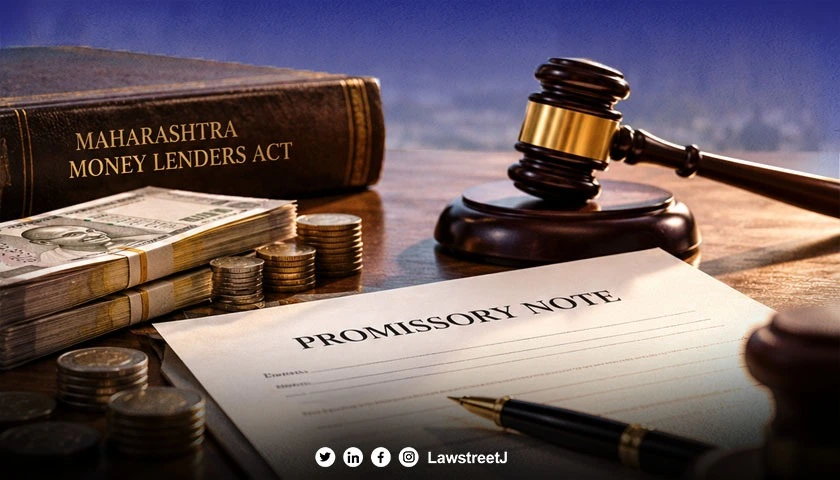
New Delhi: The Supreme Court has refused to clarify its 26.05.2026 judgment in M/s Mansi Finance (Chennai) Ltd. v. M. Lalitha as applying across India, but in doing so has observed that an advance at interest against a promissory note by an unlicensed money lender in Maharashtra is not a legally enforceable debt for the purpose of the Explanation to Section 138 of the Negotiable Instruments Act, 1881.
A Bench of Justice Prashant Kumar Mishra and Justice N.V. Anjaria was hearing Miscellaneous Application No. 3002 of 2026, filed by Vyomesh Mahipatray Shah in Criminal Appeal No. 2849 of 2026.
He sought a clarification that the Mansi Finance judgment does not apply to Section 138 proceedings by unlicensed money lenders in Maharashtra advancing money at interest against promissory notes, with or without a cheque, and that such cases continue to be governed by the Court’s order of 06.04.2026 in M.A. No. 1176/2026 in SLP (Crl.) No. 5485/2024.
The Court recalled that the Mansi Finance judgment concerned Sections 138 and 141 of the NI Act. The complainant had extended loans against promissory notes, repayment cheques were dishonoured, and the High Court had quashed the complaint for want of foundational averments on vicarious liability. This Court partly allowed the appeal and restored proceedings against three of the four accused.
The applicant argued that loans in Tamil Nadu are governed by the Tamil Nadu Money-lenders Act, 1957, which excludes advances on negotiable instruments, so that a debt secured by a negotiable instrument stays enforceable there. The Maharashtra Money-Lending (Regulation) Act, 2014, by contrast, does not exclude an advance at interest against a promissory note, so such a loan by an unlicensed lender is hit by Section 4 of that Act. Since the earlier judgment proceeded on loans against promissory notes, he said, it should be treated as having pan-India application. Intervenor Ashok Commercial Enterprises objected that the application was not maintainable, and that it is for each court to examine the ratio and apply it to the facts before it.
On the statutory scheme, the Bench noted that Section 2(13)(j) of the Maharashtra Act, unlike the Tamil Nadu Act, excludes an advance on a negotiable instrument only “other than a promissory note”. It then observed:
“Consequently, unlike Tamil Nadu, in the State of Maharashtra, such debt is not legally enforceable debt for the purpose of Explanation to Section 138 of the NI Act. In any proceedings filed on dishonour of cheque or recovery proceedings, the money lender in the State of Maharashtra has to produce a licence to satisfy the Court at the threshold.”
It added that money lending against a promissory note without a licence is prohibited by Section 4, and such a loan is unenforceable under Section 13, of the Maharashtra Act.
The Court also reproduced paragraphs 4 and 5 of its order of 06.04.2026. That order noted the statutory bar in state money-lending law on unlicensed lending against promissory notes, whether accompanied by a cheque, title deeds or other security, the “Dam Dupat” bar on interest exceeding the principal actually disbursed, the disability against enforcement by an unlicensed lender, and that such lending is punishable. It directed courts to ensure that proceedings by such private lenders, civil or criminal, are “nipped in bud” unless the lender produces a licence at the threshold or shows that the money was not advanced at interest.
Despite these observations, the Bench held that no clarification was required. In paragraph 11 of the Mansi Finance judgment it had only noted the principal contentions for quashing, and had no occasion to examine or decide on the applicability of either the Tamil Nadu or the Maharashtra Act.
That judgment did not deal with either statute. Whether Section 13 of the Maharashtra Act bars recovery by an unlicensed lender, so that the loan is not a legally enforceable debt under Section 138, is for the concerned court to examine on its merits if the plea is raised, and the parties are at liberty to raise it before the Trial Court or superior courts.
The application for clarification was accordingly disposed of.
Case Title: M/s Mansi Finance (Chennai) Ltd. vs. M. Lalitha & Ors. (In the matter of: Vyomesh Mahipatray Shah), Miscellaneous Application No. 3002 of 2026 in Criminal Appeal No. 2849 of 2026, 2026 INSC 1174