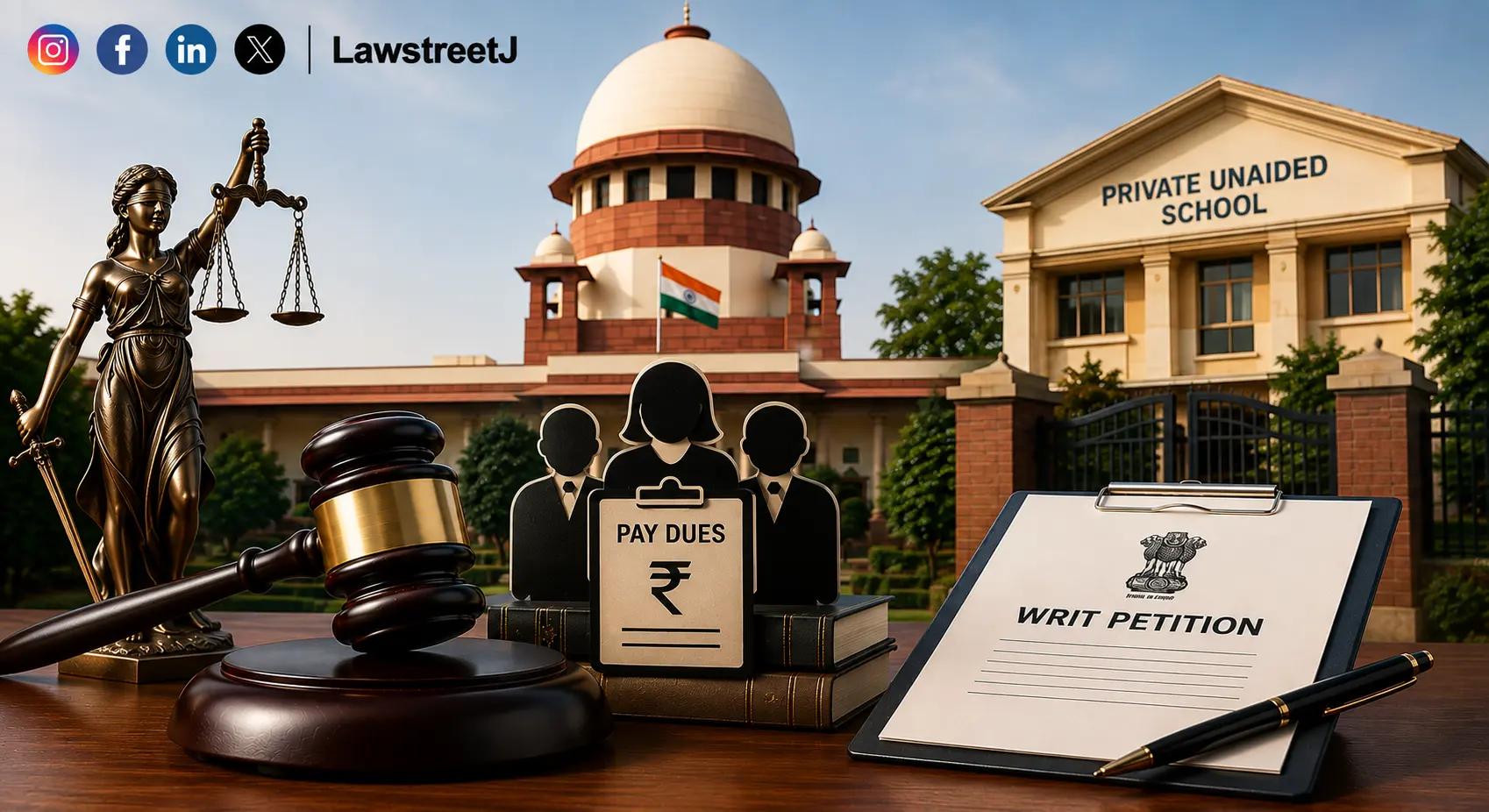
New Delhi: The Supreme Court has held that a writ petition seeking a direction upon a private unaided educational institution to pay salary to its teachers at the rate prescribed under statutory rules is maintainable, since the imparting of education by a recognised institution amounts to performance of a public duty.
A Bench of Justice Manoj Misra and Justice Vijay Bishnoi was hearing a batch of civil appeals filed by private unaided educational institutions against a common judgment of the High Court of Judicature at Bombay, Bench at Aurangabad, dated 20.03.2017, which had allowed writ petitions filed by teachers and directed the institutions to fix and pay salaries as per Schedule 'C' of the Maharashtra Employees of Private Schools (Conditions of Service) Regulation Rules, 1981, along with arrears, while quashing letters that sought to recover amounts already paid to the teachers.
The teachers had contended before the High Court that although their pay scales were initially fixed under the 1981 Rules framed under the Maharashtra Employees of Private Schools (Conditions of Service) Regulation Act, 1977, the institutions failed to implement higher scales that became applicable when the Rules were later amended. The institutions resisted the writ petitions on two grounds: that no mandamus could lie against a private unaided institution, and that the amended Rules, not having been laid before the State Legislature under Section 16(4) of the 1977 Act, were neither operable nor implementable. The High Court rejected both objections and allowed the writ petitions.
Before the Supreme Court, the appellant-institutions argued that since they were private and unaided, received no State aid, and were not instrumentalities of the State under Article 12, the dispute was purely contractual and not enforceable through a writ, relying on Army Welfare Education Society, New Delhi v. Sunil Kumar Sharma and Others, Satimbla Sharma and Ors. v. St. Paul's Senior Secondary School and Ors. and St. Mary's Education Society & Another v. Rajendra Prasad Bhargava & Others. On the second issue, relying on Association of Management of Private Colleges v. All India Council for Technical Education & Others, it was argued that since the Rules were not laid before the Legislature as mandated, they had no legal effect. The respondent-teachers supported the High Court's view, relying on K. Krishnamacharyulu and Ors. v. Sri Venkateswara Hindu College of Engineering and Anr. and Andi Mukta Sadguru Muktajee Vandas Swami Suvarna Jayanti Mahotsav Smarak Trust v. V.R. Rudani, and submitted that Atlas Cycle Industries, being a three-Judge Bench decision, squarely governed the question of the effect of non-laying.
On the question of maintainability, the Court held that while a writ petition against a private unaided institution seeking enforcement of a purely contractual right is ordinarily not maintainable, a writ would lie where the right sought to be enforced flows from a statute casting a public duty on the institution. Relying on St. Mary's Education Society, the Court held that imparting education by a recognised institution is akin to performing a public duty, that teaching staff have a direct nexus to that duty, and that a statutory mandate to pay teachers at a prescribed rate would accordingly be enforceable by writ even against a private unaided institution, distinguishing this from disputes concerning non-teaching staff. Since Section 4(3) and 4(4) of the 1977 Act cast a statutory duty on institutions to pay prescribed scales, failing which recognition could be withdrawn, the Court held the writ petitions were rightly held maintainable.
On the second issue, the Court examined the three categories of 'laying' requirements recognised in M/s Atlas Cycle Industries Ltd. and Others v. State of Haryana -- simple laying, laying subject to negative resolution, and laying subject to affirmative resolution -- and held that Section 16(4) of the 1977 Act, which did not require legislative approval as a precondition for the Rules taking effect, fell within the category of simple laying, which is directory and not mandatory. The Court further relied on the Constitution Bench decision in K.T. Plantation Private Limited & Another v. State of Karnataka, which had held an identically worded laying provision to be a curable defect not affecting the validity of the notification, and held that the earlier two-Judge Bench decision in Association of Management of Private Colleges could not be treated as binding precedent on this point, since it had not considered the larger Bench decisions in Atlas Cycle and K.T. Plantation. The amended Rules were accordingly held to be operative from the date of notification.
The Court observed:
“What is clear from the decisions above is that where the concerned provision/Section of the Act does not require the State Legislature to give its approval for bringing into effect the notification/Rule framed thereunder, the notification/Rule becomes effective from the date of its notification unless otherwise provided in the notification/Rule.”
On the institutions' plea that they should be at liberty to contest individual teachers' entitlement on facts, the Court noted that the High Court had already clarified, while rejecting a review application, that its judgment did not extend to teachers who were no longer in service, and held that parties would remain free to raise appropriate factual pleas before the appropriate forum as and when such issues arose. Finding no merit in the appeals, the Court dismissed them, with no order as to costs.
Appearances:
For the Appellant(s): Mr. Sudhanshu S. Choudhari, Senior Advocate.
For the Respondent(s): M/s. Lawyer's Knit & Co., AOR; Mr. Rahul Joshi, AOR; Mr. Aaditya Aniruddha Pande, AOR.
Case Title: Siyaram Education Society vs. Chhaya D/o Baliram Dhave & Ors., Civil Appeal No. 10063/2026 (@ SLP(C) No. 30090/2017) with connected appeals