New Delhi, India  
Breaking News
Legal Insiders

SC Adds Two New Courtrooms as Judge Strength Set to Rise to 38

By Saket Sourav      50 minutes ago      0 Comments
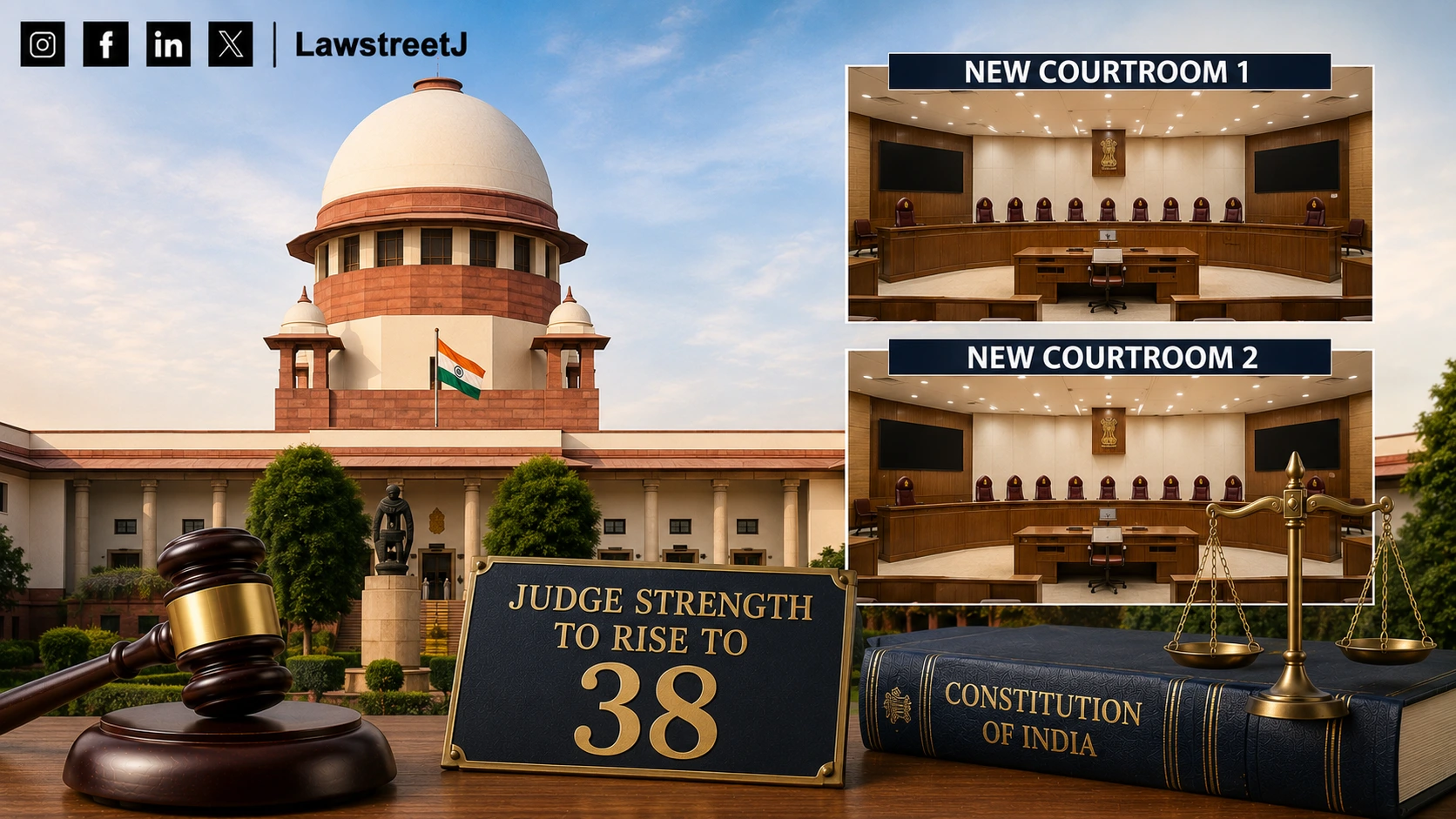
Supreme Court Adds Two New Courtrooms as Judge Strength Set to Rise to 38

New Delhi: The Supreme Court of India has created two additional Court Rooms and two Registrar Court Rooms at the First Floor of the West Wing of its Main Campus, even as the sanctioned strength of the apex court is being increased from 34 to 38 judges, including the Chief Justice of India.

As per a circular issued by the Administration General Branch of the Supreme Court Registry on August 13, 2026, pursuant to the orders of the Chief Justice of India, the newly created courtrooms have been numbered Court No. 18 and Court No. 19. Two adjoining Registrar Court Rooms have also been created and numbered Registrar Court No. 1, adjacent to Court No. 18, and Registrar Court No. 2, adjacent to Court No. 19.

The creation of additional court infrastructure comes against the backdrop of the Supreme Court (Number of Judges) Amendment Bill, 2026, which has increased the sanctioned strength of judges, excluding the Chief Justice of India, from 33 to 37. Consequently, the total sanctioned strength of the Court, including the CJI, rose from 34 to 38 judges.

Also Read: Union Cabinet Approves Expansion of Supreme Court Strength From 34 to 38 Judges

The legislation, piloted by Union Minister of State (Independent Charge) for Law and Justice Arjun Ram Meghwal, amends Section 2 of the Supreme Court (Number of Judges) Act, 1956. It is deemed to have come into force from May 16, 2026, and replaces the Supreme Court (Number of Judges) Amendment Ordinance, 2026, while saving actions already taken under the Ordinance.

Also Read: Lok Sabha Passes Bill Raising Supreme Court Judge Strength to 38

The Supreme Court (Number of Judges) Amendment Bill, 2026 has received President’s assent on August 11, 2026, increasing the sanctioned strength of judges of the Supreme Court, excluding the Chief Justice of India, from 33 to 37.




Share this article:

About:

Saket is a law graduate from The National Law University and Judicial Academy, Assam. He has a keen ...Read more

Follow:
Linkedin


Leave a feedback about this
Related Posts
View All

Another CBI Officer Investigating Rakesh Asthana Moves SC Against Transfer, Makes Startling Revelations Another CBI Officer Investigating Rakesh Asthana Moves SC Against Transfer, Makes Startling Revelations

After A.K. Bassi, another CBI officer who was investigating corruption allegations against Special Director Rakesh Asthana moved the Supreme Court.

Ayodhya verdict: SC rules in favour of Ram Lalla, Sunni Waqf Board gets alternate land Ayodhya verdict: SC rules in favour of Ram Lalla, Sunni Waqf Board gets alternate land

SC bench led by CJI Ranjan Gogoi has allotted the dispute site to Ram Janmabhoomi Nyas, while directing the government to allot an alternate 5 acre land within Ayodhya to Sunni Waqf Board to build a mosque.

Supreme Court: Money Spent On Judiciary Less Than 1% In All States Except Delhi Supreme Court: Money Spent On Judiciary Less Than 1% In All States Except Delhi

The court guided all states to document their response to the commission's report within four weeks. If any of the states fail to file a response, it will be presumed that they have no objections to the recommendations made by the commission, the court said.

Supreme Court Top Panel Names Chief Justices for Bombay, Orissa and Meghalaya High Courts Supreme Court Top Panel Names Chief Justices for Bombay, Orissa and Meghalaya High Courts

On April 18, 2020, the Supreme Court Collegium recommended new Chief Justices for three High Courts. Justice Dipankar Datta was proposed as Chief Justice of the Bombay High Court, succeeding Justice B.P. Dharmadhikari. Justice Biswanath Somadder was nominated as Chief Justice of Meghalaya High Court, while Justice Mohammad Rafiq was recommended for transfer as Chief Justice of Orissa High Court.

New Release

Senior Citizens Rights Handbook

The Senior Citizen Rights Handbook is a comprehensive guide designed to empower elderly citizens with clear and accessible knowledge of their legal and social rights in India.

Join Group

Signup for Our Newsletter

Get Exclusive access to members only content by email