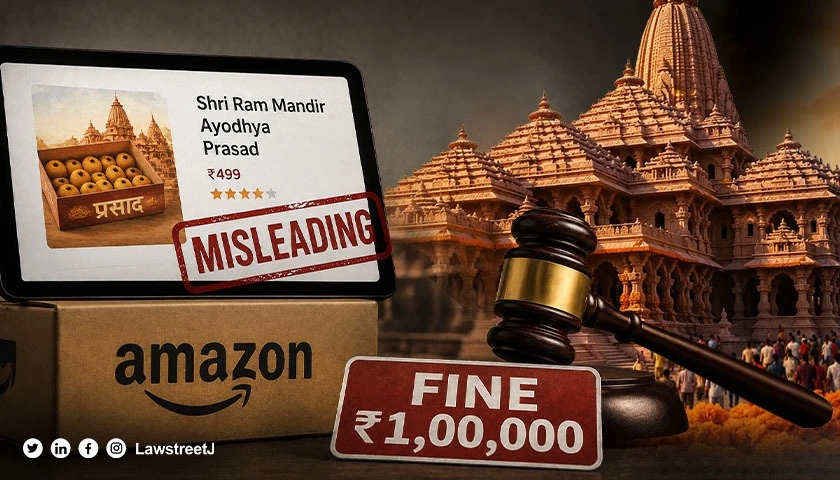
New Delhi: The Central Consumer Protection Authority has imposed a penalty of Rs 1 lakh on Amazon Seller Services Private Limited for hosting listings that falsely marketed ordinary commercial sweets as "Shri Ram Mandir Ayodhya Prasad," rejecting the e-commerce platform's safe harbour defence under the IT Act and holding that its obligations as a marketplace under the Consumer Protection Act operate independently of its status as an intermediary.
The proceedings arose from a representation dated 19th January 2024 by the Confederation of All India Traders to the Union Minister for Commerce and Consumer Affairs, alleging that Amazon Seller Services, which operates www.amazon.in, was enabling the sale of commercially produced sweets under the false label "Shri Ram Mandir Ayodhya Prasad," marketed as an exclusive offering tied to the Shri Ram Janmabhoomi Mandir without any authorisation from the temple or the Shri Ram Janmabhoomi Teerth Kshetra Trust.
On preliminary inquiry, the CCPA found four such products live on the platform, listed by seller M/s Chandu Trading Company under the brand "Bihar Brothers," priced between Rs 299 and Rs 385, using religious imagery and marketing language asserting "Blessings from Shree Ram Janam Bhumi Temple, Ayodhya," with the ingredient column itself listing the contents simply as "Ram Mandir Prasad."
Noting that the representation surfaced days before the historic Pran Pratishtha ceremony at Ayodhya on 22nd January 2024, the Authority took immediate cognizance and issued a Show Cause Notice the same day, alleging violations of Rules 4(3) and 5(3)(a) and (e) of the Consumer Protection (E-Commerce) Rules, 2020 and Sections 2(9) and 2(28) of the Consumer Protection Act, 2019.
Amazon took down the impugned listings and disclosed the seller's identity, but maintained that it operated merely as a marketplace intermediary under Section 2(1)(w) of the IT Act, claiming safe harbour under Section 79(1) and relying on Shreya Singhal v. Union of India to argue that "actual knowledge" arises only through a court order, that all sellers were contractually bound under the Amazon Business Solutions Agreement to ensure listing compliance, and that it had discharged its obligations by taking down the listings and disclosing the seller's identity. In later submissions, it additionally relied on Kent RO Systems v. Amit Kotak, MySpace Inc. v. Super Cassettes Industries and Kunal Bahl v. State of Karnataka, and argued that the Gross Merchandise Sales figure of Rs 25,26,309 reflected the seller's total transaction value rather than Amazon's own revenue, later clarifying that of Rs 39,802.29 generated by the four listings, it received only Rs 15,165.90 as service fee.
A detailed investigation by the Director General (Investigation), CCPA found that seller details, though held internally by Amazon, were not prominently displayed on the listing interface as required under Rule 5(3)(a), that the Buyer-Seller Messaging Service cited as a grievance channel required mandatory login and could not substitute the statutory disclosure obligation, and that despite contractual clauses empowering Amazon to act against deceptive sellers, no effective proactive mechanism had been shown to prevent such listings from appearing in the first place.
Rejecting the safe harbour defence, the CCPA held that the E-Commerce Rules, 2020, framed under the Consumer Protection Act, impose platform-level duties owed directly to consumers that are independent of the intermediary safe harbour under Section 79 of the IT Act, and that "compliance with one regime does not discharge obligations under the other."
It held that Shreya Singhal, decided in the context of free speech under Article 19, could not be imported into a consumer protection framework imposing affirmative, proactive and continuing duties on marketplace entities, and that a platform deriving commercial benefit from transactions on its platform could not claim complete insulation from responsibility by positioning itself as a mere conduit.
The Authority observed that the phrase "Shri Ram Mandir Ayodhya Prasad" carries a specific, well-understood meaning for Hindu devotees, and that its commercial appropriation for ordinary confectionery, without authorisation from the Shri Ram Janmabhoomi Teerth Kshetra Trust, amounted not merely to a misleading trade practice but an affront to the religious sentiments of crores of consumers, with Amazon's scale lending an inherent imprimatur of legitimacy that amplified the harm. It noted with concern that the listings remained live through the SCN's issuance just three days before the Pran Pratishtha ceremony, at the height of religious fervour, and that Amazon's initial response was to fall back on its intermediary defence rather than acknowledge any proactive obligation, with a structured due diligence framework emerging only after more than two years of hearings and interim orders.
That framework, proposed by Amazon in May 2026, covers listings using terms such as "prasad," "prasadam," "mahaprasad" or "bhog" claiming affiliation with ten major shrines including the Ram Janmabhoomi Mandir, Tirumala Tirupati Devasthanam and the Vaishno Devi Shrine.
Weighing the nationwide reach of the listings, their presence at the height of public anticipation around the consecration ceremony, and the vulnerability of devout consumers exploited by them, against Amazon's cooperative conduct in later proceedings and the absence of any prior contravention, the CCPA imposed a penalty of Rs 1,00,000 under Section 21(4) of the Act, at the lower end of the prescribed range, while cautioning that any recurrence would invite significantly more stringent action.
It directed Amazon to ensure no product falsely claiming to be prasad associated with the named institutions is listed without verifiable proof of authorisation, to prominently display seller details in compliance with the E-Commerce Rules, and to implement and periodically expand its proposed due diligence framework, with compliance to be reviewed after three to four months.
The Authority separately noted that a Show Cause Notice issued to the seller, M/s Chandu Trading Company, had drawn no response despite reminders, and that proceedings against it would continue separately.
Appearances:
For Amazon Seller Services Private Limited: Mr. Vivek Ayyagari, Ms. Mythili Girish, Mr. Saikrishna Rajagopal and Mr. Manas Raghuvanshi, Advocates.
Case Title: In the matter of Amazon Seller Services Private Limited, CCPA Case No. CCPA-2/5/2024-CCPA


![CCPA Imposes ₹7 Lakh Penalty on Vajiram & Ravi for Misleading UPSC Result Advertisements [Read Order]](/secure/uploads/2026/06/lj_7667_UPSC.webp)
![CCPA Slams PhysicsWallah With Rs 5 Lakh Fine for Dark Patterns [Read Order]](/secure/uploads/2026/06/lj_6140_CCPA_Slams_PhysicsWallah_With.webp)
![Lawyer Gets Rs 15,000 Compensation After Restaurant Charges Rs 151 Service Fee Without Consent [Read Order]](/secure/uploads/2026/06/lj_3169_Lawyer_Gets_Rs_15000_Compensation.webp)
![CCPA Imposes ₹1 Lakh Penalty On Storia Foods For Misleading "100% Tender Coconut Water" And "100% Juice" Claims [Read Order]](/secure/uploads/2026/06/lj_4344_CCPA_Imposes_1_Lakh_Penalty.webp)