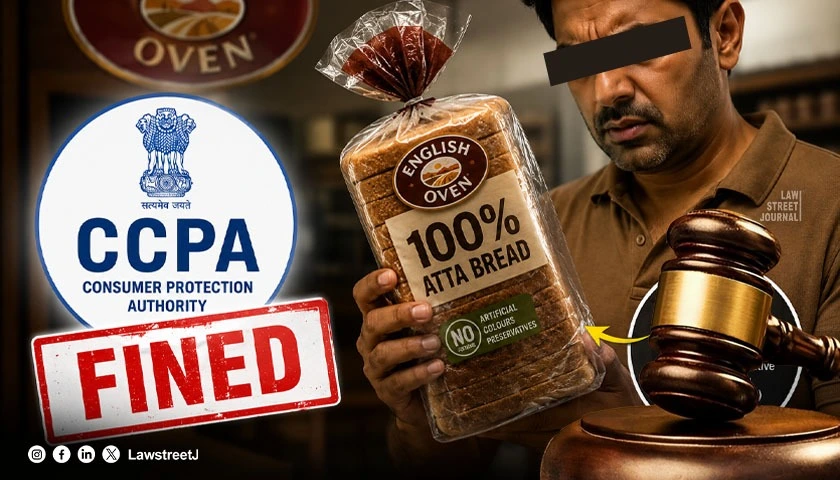
The Central Consumer Protection Authority (CCPA) has imposed a penalty of ₹1,00,000 on Mrs. Bectors Food Specialities Ltd., the maker of the English Oven range of bread products, for publishing misleading advertisements that described its bread as “100% Atta Bread” and “100% Whole Wheat Bread” while the product’s own label disclosed a whole wheat flour content of only 87%. The order, dated June 9, 2026, was passed by Chief Commissioner Nidhi Khare and Commissioner Anupam Mishra, and directs the company to take down the impugned advertisements from all platforms with immediate effect and to submit a compliance report within 15 days.
The CCPA concluded that the use of the absolute numerical qualifier “100%” in advertising a product that admittedly does not consist entirely of whole wheat flour constitutes a misleading advertisement and an unfair trade practice within the meaning of Sections 2(28) and 2(47) of the Consumer Protection Act, 2019. The Authority rejected the company’s defence that the expression “100% Atta” was intended merely to signify that wheat flour was the “sole grain source” in the product, calling it an ex post facto rationalization that “cannot override the plain and natural meaning of the representation.”
Background and Initiation of Proceedings
The matter came to the notice of the CCPA when Mrs. Bectors Food Specialities Ltd. published an advertisement on September 13, 2024 in the Hindustan Times (Delhi) for its English Oven “100% Wheat Bread,” claiming the bread was made from 100% wheat. A preliminary inquiry revealed, however, that the product’s own label disclosed wheat content of 73% and 87% for its two variants respectively, creating a direct conflict between the advertising claim and the declared composition.
A survey of the company’s promotional materials showed that the “100%” claim was not confined to a single advertisement: it ran across the company’s official website, its YouTube channel (which carried three videos accumulating a combined viewership of over 5.8 crore views), its Instagram account, and its product packaging. The advertising copy included claims such as “100% Atta Bread,” “100% Whole Wheat Bread,” “Naturally rich in Whole Grains with 100% wholemeat flour,” “Taste of 100% Nourishment,” and “The taste of 100% Wholesome Happiness.”
The CCPA sought the comments of the Food Safety and Standards Authority of India (FSSAI) on whether the advertisements complied with the Food Safety and Standards (Advertising and Claims) Regulations, 2018, and whether the product name “English Oven 100% Atta Bread” was misleading. The FSSAI, vide letter dated November 14, 2024, confirmed that the product name was “totally misleading” as the product contained only 87% whole wheat flour.
The Company’s Defence
Mrs. Bectors Food Specialities Ltd. appeared at two hearings, on February 19, 2026 and April 23, 2026, and made the following principal submissions. It contended that the expression “100% Atta” was intended solely to convey that the exclusive grain source in the product was whole wheat flour (atta), with no inclusion of refined flour (maida) or any other cereals. The company argued that no consumer could reasonably understand the claim to mean that the finished loaf consisted of atta alone, to the exclusion of water, yeast, salt and other standard baking inputs universally required to produce bread.
The company further relied on Regulation 2.6 of the Food Safety and Standards (Labelling and Display) Regulations, 2020, which prescribes only a minimum threshold of 75% whole wheat flour for bread to be classified as “Atta Bread” or “Whole Wheat Bread.” Since its product exceeded that minimum at 87%, it argued that its use of the “Atta Bread” label was fully compliant. It also submitted that the expression “100% Atta” served as a “flour-source assurance” and a “category differentiator,” distinguishing its bread from blended-flour breads that mixed atta and maida, and that the full ingredient list and the 87% atta content were disclosed transparently on the packaging.
The company also sought to shelter behind the pendency of a writ petition filed by Dabur before the Delhi High Court (W.P. (C) No. 3735 of 2025) challenging the FSSAI’s May 2025 advisory prohibiting the use of “100%” claims on food labels, arguing that the issue of the permissibility of such claims was sub judice and that it would be inappropriate to treat the advisory as conclusive.
CCPA’s Analysis and Findings
The CCPA rejected each of the company’s contentions in turn. On the regulatory argument, the Authority held that Regulation 2.6 of the 2020 Regulations prescribes only the minimum compositional threshold for classification, and that a manufacturer who voluntarily elects to use an absolute descriptor such as “100%” assumes a higher burden of accuracy. Compliance with the minimum threshold for eligibility to use the category name “Atta Bread” operates in an entirely different domain from the voluntary representation of absolute composition made in advertising. The two cannot be conflated.
“The use of the qualifier ‘100%’ is absolute, unequivocal, and admits of no dilution or interpretative flexibility. The plea that the expression ‘100% Atta’ is intended merely to signify that wheat flour is the ‘sole grain source’ is misconceived and legally unsustainable.” - CCPA Order
On the “sole grain source” defence, the CCPA found it to be a post-hoc rationalization that would, if accepted, lead to absurd and impermissible consequences: it would permit a product containing as little as 5% atta and no maida to be marketed as “100% Atta Bread.” The Authority held that the standard against which an advertising claim must be measured is not the subjective intent of the manufacturer but the objective understanding of a reasonable consumer of average intelligence, and that such a consumer would unequivocally understand “100% Whole Wheat / Atta Bread” to mean that the product is entirely composed of atta.
The CCPA also rejected the argument that expressions such as “Taste of Happiness” and “Tasty” were mere subjective puffery. While conceding that such taglines fall within the realm of permissible opinion-based marketing, the Authority held that the principle of puffery cannot be extended to the objective and quantifiable claim “100% Atta,” which is a definitive representation capable of verification and which the company had itself admitted was factually incorrect. “The Opposite Party’s attempt to conflate inherently subjective taglines with an absolute compositional claim is therefore unsustainable and misleading,” the order states.
On the Dabur litigation, the CCPA held that the mere pendency of a challenge to a regulatory directive does not dilute the enforcement force of that directive, and that regulatory authorities are not precluded from discharging their statutory obligations merely because a similar issue is sub judice in a case involving a different party. In the absence of any interim protection granted by the court, the FSSAI’s directive and advisory continue to hold the field.
As regards the investigation findings, the DG (Investigation) CCPA’s report dated January 5, 2026 noted that despite the initiation of regulatory proceedings, the company continued to market its product under the names “100% Whole Wheat Bread” and “100% Atta Bread” across its packaging, social media platforms and e-commerce listings. The CCPA held that the continued availability of the impugned content, despite the lapse of a considerable period since the original notice and the initiation of regulatory scrutiny, “evinces a conscious and deliberate omission to withdraw or suitably modify the impugned advertisements” and “reflects a clear and sustained intent to persist with representations that are prima facie misleading in nature.”
Directions
The CCPA directed Mrs. Bectors Food Specialities Ltd. to discontinue the false and misleading advertisement with immediate effect from all print and electronic media, including social media. The company has been directed to pay a penalty of ₹1,00,000 under Section 21 of the Consumer Protection Act, 2019, and to submit a compliance report to the CCPA within 15 days of the date of the order. The order was passed in exercise of the powers conferred under Sections 10, 18, 20 and 21 of the Consumer Protection Act, 2019.
Order Details
- Authority: Central Consumer Protection Authority (CCPA)
- File Number: CCPA-2/172/2024-CCPA [E-35629]
- Coram: Smt. Nidhi Khare, Chief Commissioner; Shri Anupam Mishra, Commissioner
- Date of Order: June 9, 2026
- Opposite Party: Mrs. Bectors Food Specialities Ltd. (Mrs. Bector’s English Oven bread)
- For Opposite Party: Shri Salil Seth, Ld. Counsel; Shri Saransh Garg, Ld. Associate Counsel

![CCPA Imposes ₹7 Lakh Penalty on Vajiram & Ravi for Misleading UPSC Result Advertisements [Read Order]](/secure/uploads/2026/06/lj_7667_UPSC.webp)
![CCPA Slams PhysicsWallah With Rs 5 Lakh Fine for Dark Patterns [Read Order]](/secure/uploads/2026/06/lj_6140_CCPA_Slams_PhysicsWallah_With.webp)
![Lawyer Gets Rs 15,000 Compensation After Restaurant Charges Rs 151 Service Fee Without Consent [Read Order]](/secure/uploads/2026/06/lj_3169_Lawyer_Gets_Rs_15000_Compensation.webp)
![CCPA Imposes ₹1 Lakh Penalty On Storia Foods For Misleading "100% Tender Coconut Water" And "100% Juice" Claims [Read Order]](/secure/uploads/2026/06/lj_4344_CCPA_Imposes_1_Lakh_Penalty.webp)