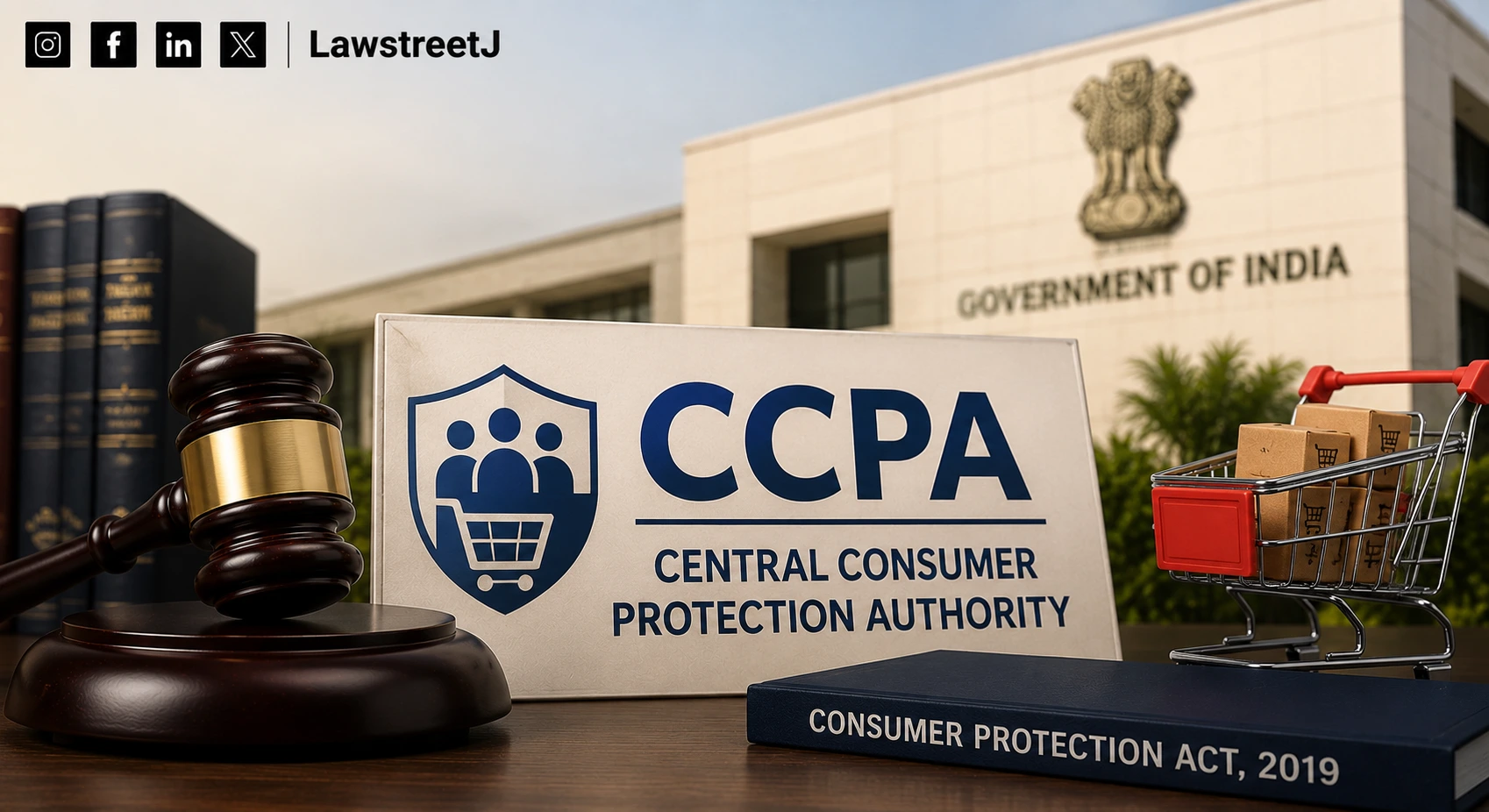
The Central Consumer Protection Authority has imposed a penalty of Rs 50,000 on Chaayos (Sunshine Teahouse Pvt. Ltd.) for mandatorily levying service charge on a customer's bill in defiance of the CCPA's 2022 guidelines and the Delhi High Court's judgment outlawing such default charges, directing the restaurant chain to reimburse the amount collected and strip the charge from its billing software.
The Authority, comprising Chief Commissioner Ms. Nidhi Khare and Commissioner Mr. Anupam Mishra, took suo-moto cognizance of a grievance filed by consumer Mr. Shahank Sood on the National Consumer Helpline, who complained that Chaayos had charged a "Service Charge" separately over and above CGST and SGST, and that the restaurant refused to refund the amount on the ground that the charge was mandated by company management and was non-refundable.
The bill in question, dated 30.03.2025, showed a service charge of 3.50 per cent levied on the order in addition to CGST and SGST. The CCPA noted that the bill was software-generated, indicating that the practice was likely to be affecting a wider base of consumers visiting the restaurant, thereby forming a case for class action under Section 10 of the Consumer Protection Act, 2019.
Acting under Section 18(2) and Section 19 of the Act, the CCPA conducted a preliminary inquiry and issued a notice to the restaurant on 25th April, 2025 for violation of the Act and the Guidelines to Prevent Unfair Trade Practices and Protection of Consumer Interest with Regard to Levy of Service Charge in Hotels and Restaurants, issued on 04.07.2022.
In its response, Chaayos submitted that the service charge levied at its outlets was not mandatory but entirely voluntary, applied at the discretion of the consumer, and that it maintained a consistent practice of waiving or refunding the charge upon request, with signage displayed at the point of sale informing customers of this option. The company denied that Mr. Sood had ever sought a refund and stated that the charge was collected under the clearly defined term "Optional Service Charge."
The CCPA found this explanation unpersuasive, observing that the restaurant had not justified why the charge was imposed by default despite the 2022 Guidelines expressly stating that no hotel or restaurant shall add service charge automatically or by default in the bill, a position upheld by the Delhi High Court. Satisfied that a prima facie case of unfair trade practice existed, the Authority directed the Director General (Investigation) to conduct a detailed inquiry on 14th May, 2025.
The investigation report, submitted on 19th May, 2026, found that the Delhi High Court, in its judgment dated 28.03.2025 in National Restaurant Association of India & Ors. v. Union of India & Anr., had held that the mandatory collection of service charge was contrary to law, and that any amount ought not to be added by default and must be left to the customer's discretion. Despite this binding pronouncement, the report found, Chaayos had levied the charge on the consumer's bill dated 30.03.2025, added by default rather than at his discretion.
The investigation further found that the National Consumer Helpline had issued an initial communication to the company on 04.04.2025 followed by reminders on 11.04.2025 and 15.04.2025, none of which drew a substantive response, and that while Chaayos later revised its invoice format to describe the levy as an "Optional Service Charge" and updated its Standard Operating Procedures, these measures were undertaken only after the charge had already been imposed in violation of the Guidelines and the High Court's judgment.
The Investigating Authority concluded that the company had violated the Consumer Protection Act, 2019 by imposing the service charge post-judgment without consumer discretion, failing to redress the consumer's grievance despite repeated reminders, and engaging in default billing practices contrary to law, bringing its conduct within the ambit of Sections 2(47) and 2(9) of the Act.
At the hearing held on 10th June, 2026, counsel for Chaayos submitted that the company did not compulsorily levy the charge, that revising billing software and SOPs across its 180-plus outlets required coordination with its software vendor, and that the restaurant had in fact stopped levying service charge from 1st May, 2025. The company also placed on record that it had written to the complainant seeking his bank details to process a refund of the amount collected.
Rejecting the restaurant's defence, the CCPA held that the genesis of the service charge lay in a command embedded in the billing software that added it to every bill by default, which effectively negated the company's claim that the levy was voluntary. The Authority found that the charge had been mandatorily levied on all consumers until 1st May, 2026, and that the restaurant's failure to update its billing system until that date showed no reasonable effort to align its practices with the law.
Holding that the conduct amounted to unfair trade practice and misleading advertisement under Sections 2(47), 2(46)(vi) and 2(28) of the Act, and violated consumer rights under Section 2(9), the Authority observed that the restaurant's "liability is also established through a clear pattern of deliberate non-compliance of the Guidelines, 2022 issued by CCPA which has been upheld by the Hon'ble High Court of Delhi."
Taking into account the restaurant's pan-India presence of over 180 outlets and the potential impact of default service charge billing on a large class of consumers, the CCPA invoked Section 21(7) of the Act and directed Chaayos to reimburse the service charge paid by the complainant, to immediately modify its billing software to remove the default addition of service charge or any charge by another name, and to pay a penalty of Rs. 50,000. The restaurant was directed to submit a compliance report within 15 days of receipt of the order.
Appearances:
For the Restaurant: Mr. Nikhil Mandhotra, Advocate.
Case Title: In the matter of Chaayos (Sunshine Teahouse Pvt. Ltd.), CCPA Case No. CCPA- 2/16/2025-CCPA


![CCPA Imposes ₹7 Lakh Penalty on Vajiram & Ravi for Misleading UPSC Result Advertisements [Read Order]](/secure/uploads/2026/06/lj_7667_UPSC.webp)
![CCPA Slams PhysicsWallah With Rs 5 Lakh Fine for Dark Patterns [Read Order]](/secure/uploads/2026/06/lj_6140_CCPA_Slams_PhysicsWallah_With.webp)
![Lawyer Gets Rs 15,000 Compensation After Restaurant Charges Rs 151 Service Fee Without Consent [Read Order]](/secure/uploads/2026/06/lj_3169_Lawyer_Gets_Rs_15000_Compensation.webp)
![CCPA Imposes ₹1 Lakh Penalty On Storia Foods For Misleading "100% Tender Coconut Water" And "100% Juice" Claims [Read Order]](/secure/uploads/2026/06/lj_4344_CCPA_Imposes_1_Lakh_Penalty.webp)
.jpeg)