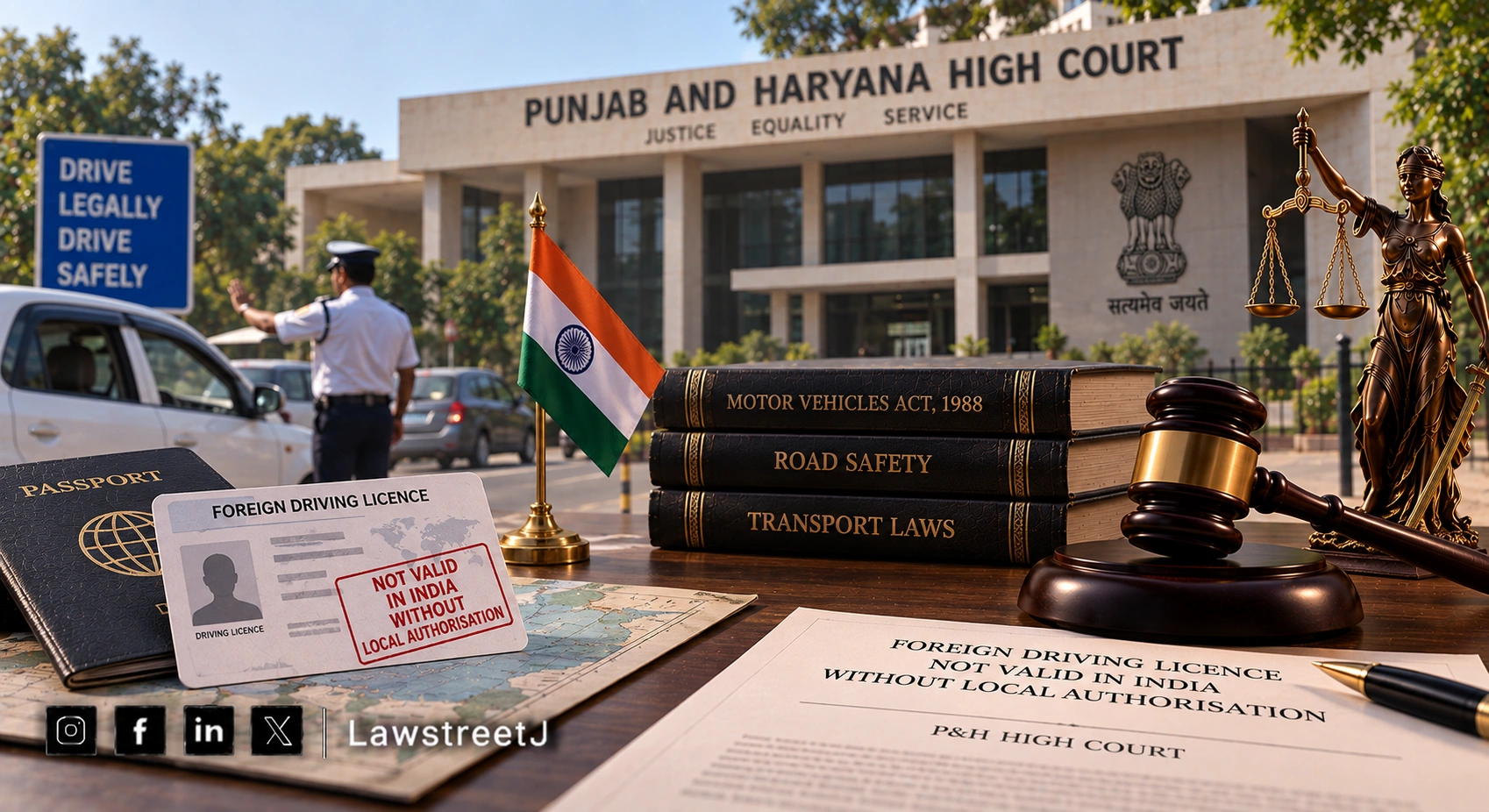
Chandigarh: The High Court of Punjab and Haryana has declined to exonerate a motorist from his liability in a fatal motor accident claim, holding that a driving licence issued by a foreign authority, without an international driving permit or endorsement recognised under Indian law, does not entitle its holder to drive a vehicle in India, and upholding the Insurance Company's right to recover the compensation paid to the claimants from the driver and the owner of the offending vehicle.
Justice Deepak Gupta was hearing an appeal filed by the driver of the offending car against the award dated 27.05.2016 passed by the Motor Accidents Claims Tribunal, Kurukshetra, challenging only the portion of the award granting the Insurance Company a right to recover the compensation payable by it from the appellant-driver and the owner of the vehicle. Mr. Prateek Mahajan and Ms. Arche Anant, Advocates, appeared for the appellant, and Mr. Vinod Chaudhari, Advocate, appeared for the respondents.
The claim arose out of a motor vehicular accident dated 31.08.2015, in which Jivika, an infant aged about nine months, lost her life. The Tribunal had awarded compensation of Rs.2,49,500 with interest at 9% per annum, holding the appellant-driver and the owner of the offending car jointly and severally liable, and directing the insurer to satisfy the award in the first instance with liberty to recover the amount from the driver and the owner, on the finding that the appellant did not possess a valid and effective driving licence to drive the vehicle in India.
The appellant contended that he had denied driving the offending vehicle from the outset, and that Pankaj Kumar, who had identified him as the driver before the Tribunal, subsequently deposed in the criminal trial that he could not see who was driving the car, resulting in the appellant's acquittal. He further submitted that, even if he was driving, he held a valid driving licence issued by the competent authority in Victoria, Australia, and that the Tribunal had erred in disregarding it merely because it was not issued or endorsed by an Indian authority.
Rejecting the challenge to the finding on identity, the Court held that Pankaj Kumar's testimony before the Tribunal, corroborated by the FIR lodged on the date of the accident and the police report under Section 173 Cr.P.C., could not be displaced merely by his subsequent, inconsistent statement in the criminal trial. The Court observed that a criminal acquittal, based on the standard of proof beyond reasonable doubt, does not ipso facto exonerate a person from civil liability determined on the touchstone of preponderance of probabilities, and that the appellant had produced no independent evidence to show that someone else was driving the car at the relevant time.
Turning to the licence issue, the Court noted that the appellant had admitted in cross-examination that he possessed no driving licence issued by an Indian authority, and that the only document produced was an Australian domestic driving licence, unaccompanied by any international driving permit or endorsement by a competent Indian authority.
Reiterating the settled legal position, the Court observed that “a foreign driving licence does not, merely because it is valid in the country of its issuance, automatically confer a right upon its holder to drive a motor vehicle in India.”
Relying on its earlier decision in Dilpreet Singh and another v. United India Insurance Company Limited Goryana and others, where a Canadian licence without the requisite Indian endorsement was similarly held insufficient, the Court found no error in the Tribunal's conclusion that the appellant lacked a valid and effective driving licence at the time of the accident.
On the question of recovery, the Court relied on National Insurance Company Limited v. Swaran Singh and others and Shamanna and another v. Divisional Manager, The Oriental Insurance Company Limited and others, holding that the insurer was entitled to satisfy the award in the first instance and thereafter recover the amount from the driver and owner responsible for the breach of policy conditions.
Finding no illegality or perversity in the Tribunal's findings, the Court dismissed the appeal, clarifying that the dismissal would not affect the claimants' right to receive or retain the compensation awarded to them, and that the Insurance Company would remain liable to satisfy the award in the first instance while retaining its liberty to recover the amount from the appellant and the owner of the vehicle.
Appearances:
For the Appellant: Mr. Prateek Mahajan and Ms. Arche Anant, Advocates.
For the Respondents: Mr. Vinod Chaudhari, Advocate.
Case Title: Sameer Gaba vs. Priyanka and Others, FAO-6604-2016


![Police protection to fund manager alleging threat from Kirron Kher & aide: Punjab & Haryana HC [Read Order]](/secure/uploads/2023/12/lj_9007_Police_Kirron_Kher.jpg)
![Most interested witness being the father of deceased, SC upholds acquittal of 6 accused for murder [Read Judgment]](/secure/uploads/2023/12/lj_9904_df2c02a2-d8c5-4dd6-8b58-a59e17b8635b.jpg)
![Supreme Court Collegium approves new Chief Justices for five key High Courts in India [Read Recommendations]](/secure/uploads/2023/12/lj_8000_380d1135-6f3a-4988-a00a-4d5cd5901815.jpg)