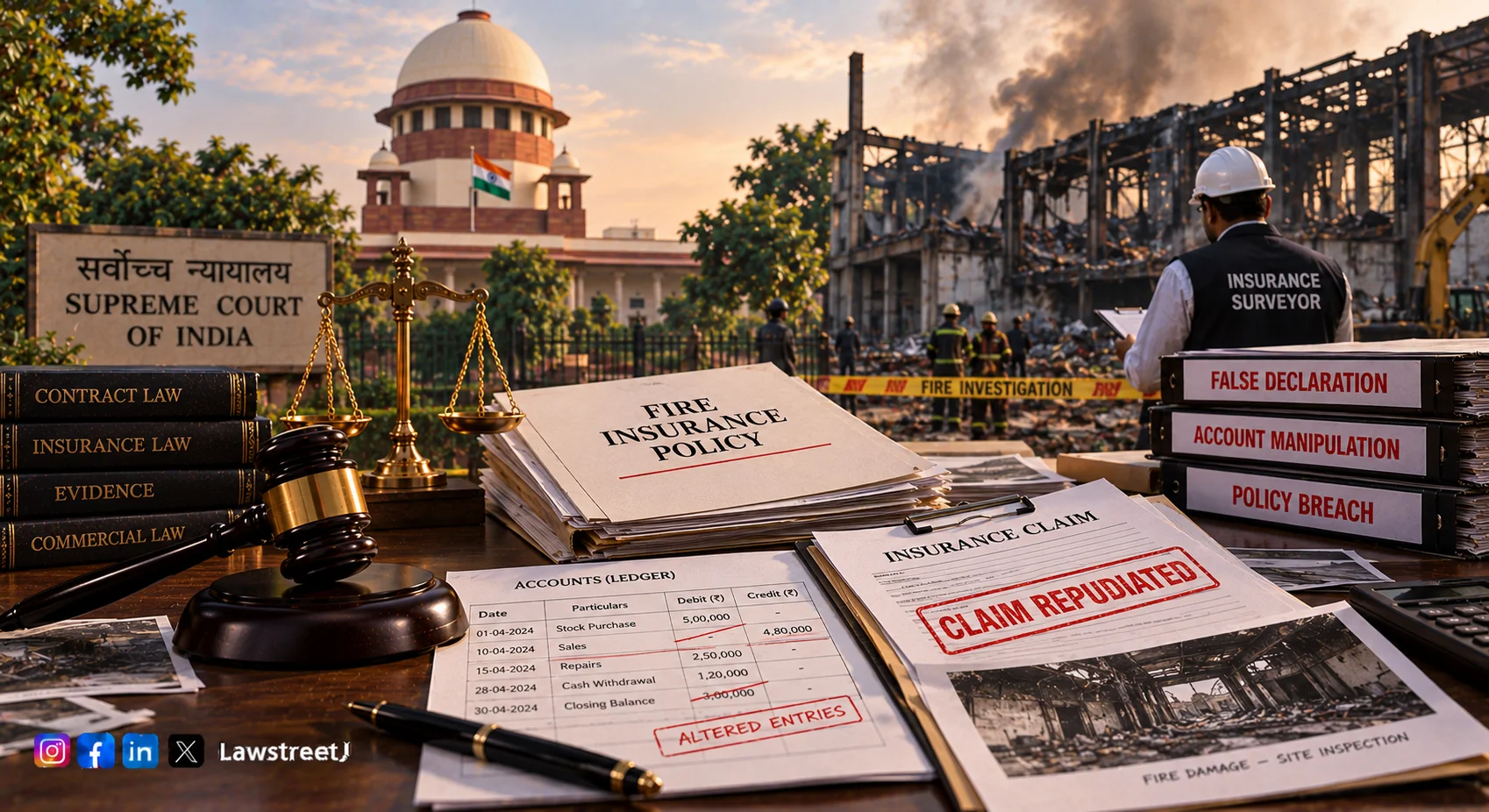
New Delhi: The Supreme Court has set aside an order of the National Consumer Disputes Redressal Commission (NCDRC) that had directed an insurance company to pay over Rs. 2.4 crore, along with compensation and costs, to a paper-board manufacturer for a factory fire, holding that the surveyors' and investigators' reports showed strong indications of a fabricated fire and manipulated books of account, and that the insurer's repudiation of the claim for breach of the policy's disclosure and no-false-declaration conditions was fully sustainable.
A Bench of Justices Sanjay Kumar and Sanjeev Sachdeva was hearing Civil Appeal No. 7221 of 2025, filed by M/s. New India Assurance Company Ltd., along with connected Civil Appeal No. 11416 of 2025, filed by M/s. Hemkund Duplex and Board Pvt. Ltd., both arising from an order dated 19.11.2024 passed by the NCDRC, New Delhi, in Consumer Complaint No. 66 of 2011.
The respondent company, which took over a sick paper-board manufacturing unit at Najibabad in 2005, had insured its stock and its buildings, plant and machinery with the appellant under two separate fire policies. On 07.05.2009, a fire broke out in the waste paper yard of the factory, damaging raw material and a tin shed, and the respondent lodged a claim, initially reporting losses ranging from Rs. 15 crore to the media down to Rs. 7.31 crore in its final claim. The appellant's preliminary surveyor, R.C. Bajpai, tentatively assessed the loss at about Rs. 56.46 lakh but flagged the need for meticulous investigation to rule out a deliberate fire, while a detective agency, Royal Associates, found the cause of the fire unclear and noted several suspicious circumstances, including that the tin shed appeared to have been broken down by a JCB machine before the fire and that fire brigade personnel were informed roughly an hour late despite being stationed nearby. The final surveyor, Aditi Consultants, assessed the actual loss at about Rs. 46.09 lakh, far below the claimed amount, and concluded that the respondent's books of account had been manipulated to inflate the claim. On this basis, the appellant repudiated the claim on 28.06.2010, citing breach of Policy Condition Nos. 6 and 8 relating to full disclosure and the prohibition on false declarations, leading the respondent to approach the NCDRC, which found no reason to doubt the respondent's claim, assessed the loss independently at a considerably higher figure, and awarded compensation accordingly, prompting cross-appeals by both parties to the Supreme Court.
The Court examined in detail the findings of the three reports on record. It noted that the preliminary surveyor had found the claimed eyewitness Anil Kumar's account doubtful, ruled out short-circuit or cigarette-related causes given the absence of electrical connections and a strict no-smoking policy at the isolated yard, observed that the extent of burn damage to the tin sheets was inconsistent with the scale of loss claimed, and recorded discrepancies between book stock and physical stock. The investigative agency's report similarly found the cause of the fire unclear and recorded statements from the JCB owner, factory workers and nearby shopkeepers that the tin shed had in fact been broken down by a JCB before the fire, contradicting the respondent's version that the JCB was called in only during fire-fighting to lift collapsed sheets. The Court also noted worker and accountant testimony, unchallenged by the respondent, indicating that only old, unusable waste paper, not the usable raw material claimed, had been stored in the tin shed that burnt, along with an unexplained and drastic drop in the raw-material-to-sales ratio between 2007-08 and 2008-09, absence of stock and stock-movement registers, and other bookkeeping irregularities pointing to inflation of the claim.
Reiterating the settled position on the role of insurance surveyors under Section 64UM of the Insurance Act, 1938, drawn from New India Assurance Co. Ltd. v. Pradeep Kumar, Khatema Fibres Ltd. v. New India Assurance Co. Ltd., Sri Venkateswara Syndicate v. Oriental Insurance Co. Ltd. and United India Insurance Co. Ltd. v. Roshan Lal Oil Mills Ltd., the Court held that a surveyor's report, while an important document that a consumer forum cannot ignore without cogent reasons, is not conclusive or binding on either the insurer or the insured, and that an insurer's rejection of a claim based on such findings can be interfered with only where the discretion to depart from the report is shown to have been exercised arbitrarily or whimsically.
The Court held that the respondent had breached Policy Condition No. 6, requiring full and honest disclosure, and Policy Condition No. 8, prohibiting false declarations, and that the material on record, including contradictory statements of its own Vice President, General Manager, supervisors and accountants, along with unexplained financial irregularities, demonstrated that false statements had been made to bolster the insurance claim, entitling the insurer to reject the claim on that ground alone, independent of whether the fire itself was deliberate. It held that the NCDRC was not justified in brushing aside the detailed findings of the two surveyors' reports without basis, in holding that there was no delay in informing the fire brigade, or in undertaking its own assessment of the loss at a figure far exceeding that computed by the surveyors, without adequately engaging with the substantial adverse material on record.
Accordingly, the Court allowed Civil Appeal No. 7221 of 2025 filed by the insurer, set aside the NCDRC's order dated 19.11.2024, and, as a consequence, dismissed Civil Appeal No. 11416 of 2025 filed by the respondent seeking enhancement of compensation. The Registry was directed to return to the appellant the suitor's fund amount and the Rs. 50 lakh earlier deposited by it pursuant to the interim stay order, along with accrued interest, with parties bearing their own costs.
Case Title: M/s. New India Assurance Company Ltd. vs. M/s. Hemkund Duplex and Board Pvt. Ltd., Civil Appeal No. 7221 of 2025, with Civil Appeal No. 11416 of 2025


.jpeg)