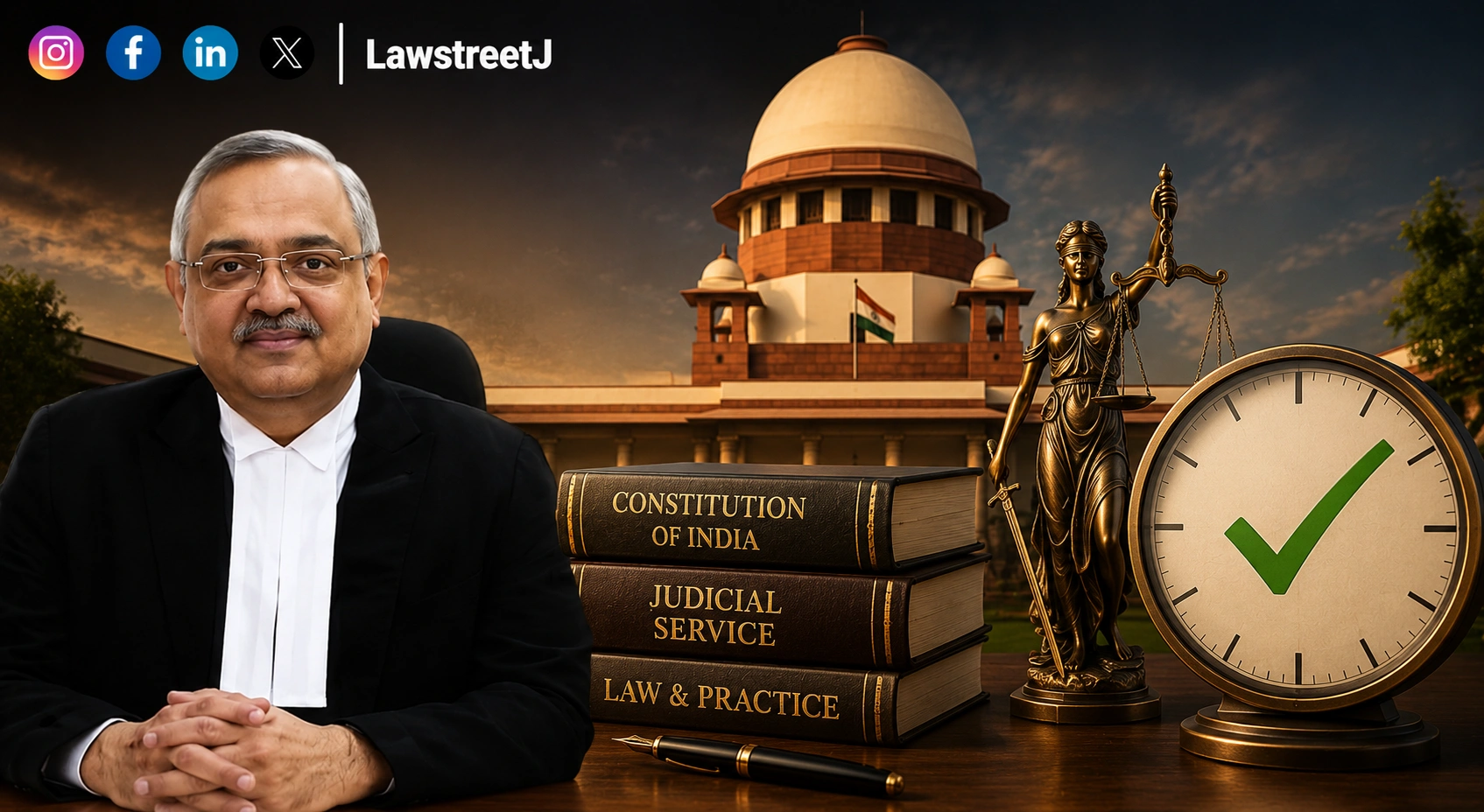
New Delhi: While the Chief Justice of India, Surya Kant, and Justice Augustine George Masih softened the three-year Bar practice requirement for entry-level judicial recruitment through a transitional training scheme, Justice K. Vinod Chandran dissented, holding that there was no ground to review the judgment restoring the requirement at all, and that the controversy over its wisdom "should rest there."
The batch of matters before the Supreme Court concerned a 2025 judgment that had restored a mandatory three-year period of practice at the Bar as a condition for candidates to sit the examination for Civil Judge (Junior Division), reversing a position that had allowed fresh law graduates to enter judicial service directly for over two decades. While the majority devised a transitional scheme permitting fresh graduates to apply for a defined period, subject to a year of institutional training and a year of Law Clerkship treated as equivalent to Bar practice, Justice Chandran rejected the case for any relief altogether.
He first took up the argument that a two-judge Bench could not, in effect, alter a rule earlier laid down by a three-judge Bench. He held this to be "outrightly fallacious," explaining that the line of judgments on judicial recruitment, running from the first All India Judges' Association case through to the judgment under review, has proceeded as a continuing mandamus, under which this Court has repeatedly revisited and refined its own directions as circumstances required.
He was equally unpersuaded by the comparison drawn with recruitment to services such as the IAS, IFS and IPS, which do not require prior work experience. Judicial service, he reasoned, admits of no equivalent supervisory correction: a wrong judicial order cannot found a disciplinary proceeding and can only be corrected in appeal or revision, whereas civil service hierarchies retain administrative control over the discharge of duties by their officers at every level. On this basis, he held that judicial recruitment could not be equated with recruitment to the wider civil services.
On the submission that three years of practice serves little purpose because a junior lawyer is rarely entrusted with independent conduct of a brief, Justice Chandran wrote that this misconceives what practice actually teaches. It is not, he said, the arguing of cases that shapes a young lawyer in the initial years, but rather “the familiarity with the files… acquired from the office of a Senior and the interactions she has with the fraternity of lawyers in the corridors of the Court.”
Justice Chandran reserved his sharpest objection for the training-and-clerkship framework itself. Requiring recruits to spend two years on half-pay, without that period counting as service, would in his view deter capable candidates, strain the exchequer, and leave courts unmanned while vacancies mounted through retirements and promotions. He further noted that subjecting candidates with differing amounts of prior practice one year against several to an identical training regime risked either treating unequals as equals or inviting a fresh claim of discrimination between recruits from the very same selection process.
While he expressed full agreement with the Chief Justice's view that some prior exposure to the working of courts is desirable for new entrants, Justice Chandran maintained that “experience at the Bar is essential for students right out of college.”
He also took exception to submissions before the Court that had described the restoration of the three-year requirement as resting on "anecdotal observations, prejudices and subjective reviews" of the High Courts, calling the language disparaging and undeserving of any weight, given that the High Courts remain in constant administrative touch with the performance of the District Judiciary through evaluations for promotion and supervision by Administrative and Portfolio Judges.
In his concluding observations, Justice Chandran wrote that the forensic and analytical skills required of a judge are better learned by observing proceedings as a student of the profession than through any structured training regime, since a presiding officer's error can only be undone on appeal, whereas a lawyer's error can still be caught and corrected by a senior, an experienced judge, or an alert member of court staff.
He accordingly held that there was no scope to review the judgment under review, and that the Review Petitions ought to be dismissed, leaving the pending applications and writ petition to be placed before the regular Bench seized of the continuing mandamus.
Case Title: Bhumika Trust v. Union of India & connected matters



.jpeg)