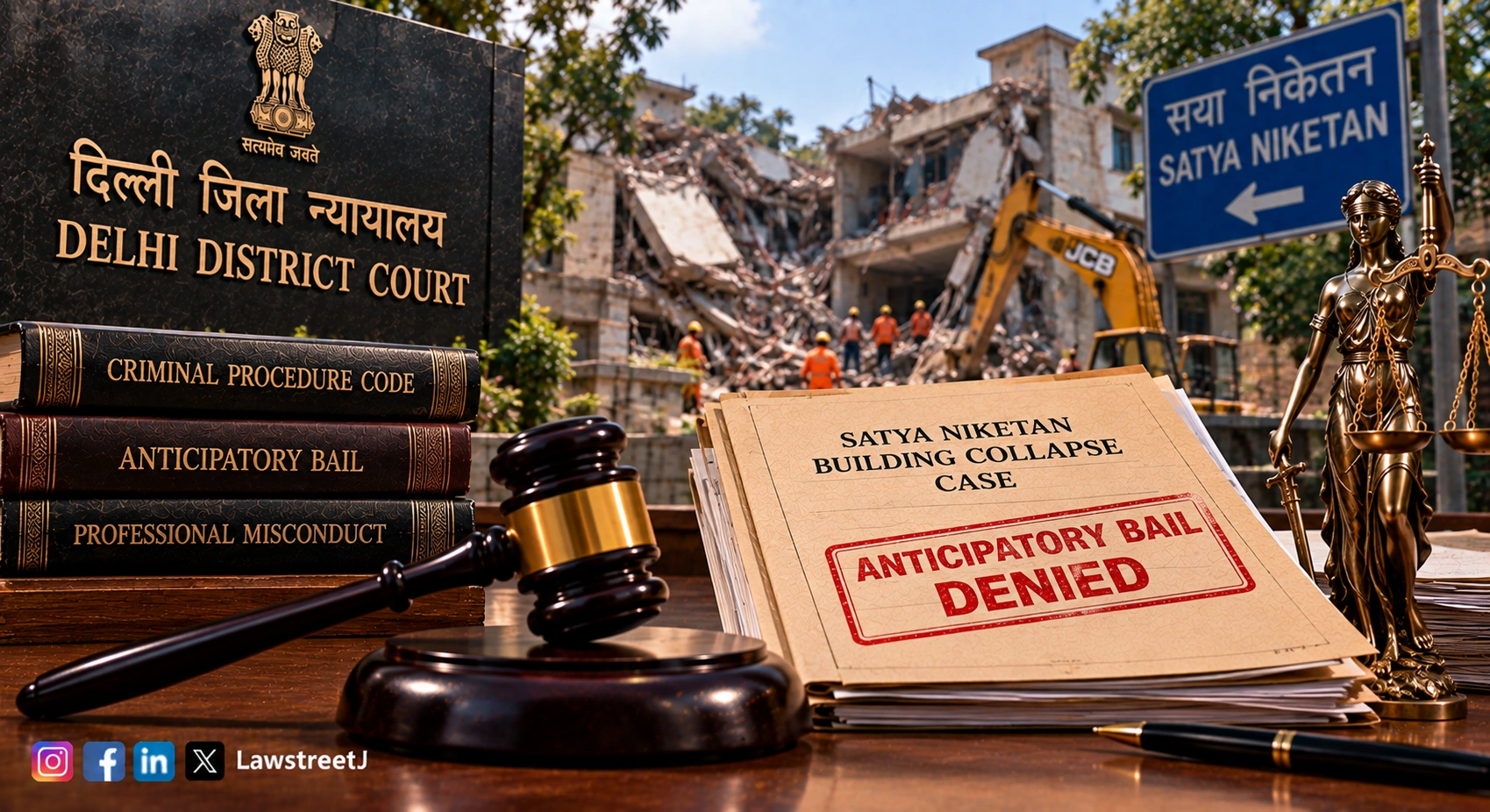
New Delhi: The Patiala House Court has dismissed the anticipatory bail application of advocate Shubham Tyagi, accused in connection with the collapse of a paying-guest building in Satya Niketan that claimed the lives of seven persons, holding that the suppression of his own rent agreement for two floors of the building undermined his claim of being merely a financial investor with no operational role.
Additional Sessions Judge Saurabh Partap Singh Laler was hearing Tyagi’s first application under Section 482 of the Bharatiya Nagarik Suraksha Sanhita, 2023, in FIR No. 153/2026 registered at Police Station South Campus under Sections 105, 290 and 125(a) of the Bharatiya Nyaya Sanhita, 2023.
The prosecution case was that on September 6, 2026, a building housing the “Hostel Daze / Hosteldaze (PG)” facility at Satya Niketan Market, Moti Bagh-II, collapsed. Seven persons, including five students and two labourers, died, while several others were injured. The FIR stated that the building was old, additional floors had been constructed over the years and construction activity was underway, with the load-bearing capacity allegedly exceeded. The precise structural cause was stated to be under expert examination.
Also Read: SC Keeps Satya Niketan Case With Delhi HC, Seeks Citywide Action On Illegal PGs
Tyagi claimed that he was merely a friend who had invested money in a PG business operated by co-accused Sudhanshu Lovenish Kumar. He argued that he had no title, control or decision-making authority over the building and that the FIR did not attribute any specific overt act to him. He further relied on a rent agreement executed in Sudhanshu’s favour for the upper ground and first floors, which prohibited structural alterations.
The State, however, contended that Tyagi was not a mere investor but a co-lessee and business partner of Sudhanshu, jointly operating PG accommodations under the name “Hotel / Hostel Daze” in three buildings in Satya Niketan.
A significant factor against Tyagi was the existence of another rent agreement dated September 6, 2025, under which he himself was the lessee of the second and third floors of the same building. The agreement had not been disclosed in his anticipatory bail application. The Court noted that both agreements covered the same period, contained substantially similar terms, were attested by the same notary and were executed using e-stamp papers purchased within minutes of each other. Each accused had also signed as a witness to the other’s agreement.
The Court held that an applicant seeking the discretionary protection of anticipatory bail owes a duty of candour to the Court and that suppression of such a material document weighed heavily against the grant of relief. The suppressed agreement also weakened Tyagi’s claim that he had no direct connection with the premises.
The prosecution further relied on the statement of injured paying guest Nitish Chib, who stated that he had taken accommodation from both Tyagi and Sudhanshu. According to the statement, students had complained to both operators about construction noise and the cutting of iron rods. They were allegedly told that renovation was underway and that the PG would eventually be extended to the basement, with eviction threatened if they objected.
Examining the material at the limited stage of anticipatory bail, the Court held that Tyagi could not be treated as a stranger to the building. He had himself leased two floors for operating a boys’ PG, while material on record indicated his association with the business and knowledge of the construction activity.
The Court clarified that it was not deciding whether the ingredients of Section 105 BNS, corresponding to culpable homicide not amounting to murder, were ultimately established. However, it held that further investigation was necessary into Tyagi’s role, the extent of his partnership with Sudhanshu, the flow of rent collected from students, and his knowledge or consent regarding the structural work.
The Court also rejected the argument that the lease had expired on August 30, 2026, observing that this did not erase his association with the premises or the material collected during investigation. His clean antecedents and professional status as an advocate were also not considered sufficient to outweigh the suppression of the rent agreement and the other material requiring investigation.
Accordingly, the Court held that the case was not fit for grant of anticipatory bail and dismissed the application. It clarified that its observations were confined to the bail proceedings and would not prejudice the applicant during investigation, framing of charges or trial. Any arrest, the Court added, would have to be carried out strictly in accordance with law and the Supreme Court’s guidelines governing arrest.
Appearances:
For the State: Sh. Mukul Kumar, Ld. Addl. PP.
For the Applicant/Accused: Ms. Ankita Gautam, Sh. Abhishek Sharma, Sh. Harsh Gautam, Sh. Keshav Pratap Singh and Sh. Neeraj Kanwar, Ld. Counsels.
Case Title: State vs. Shubham Tyagi, Bail Application No. 2254/2026


![Delhi Court Grants Permission to Evict AAP MP Raghav Chadha from Type 7 Government Bungalow [Read Order]](/secure/uploads/2023/10/lj_2396_AAP_MP_Raghav_Chadha_to_lose_govt_bungalow.jpg)
![Delhi Court Grants Bail in ‘False Promise to Marry’ Case, Calls It a Consensual Relationship Between Adults [Read Order]](/secure/uploads/2026/05/lj_9957_Delhi_Court_Grants_Bail_in.webp)