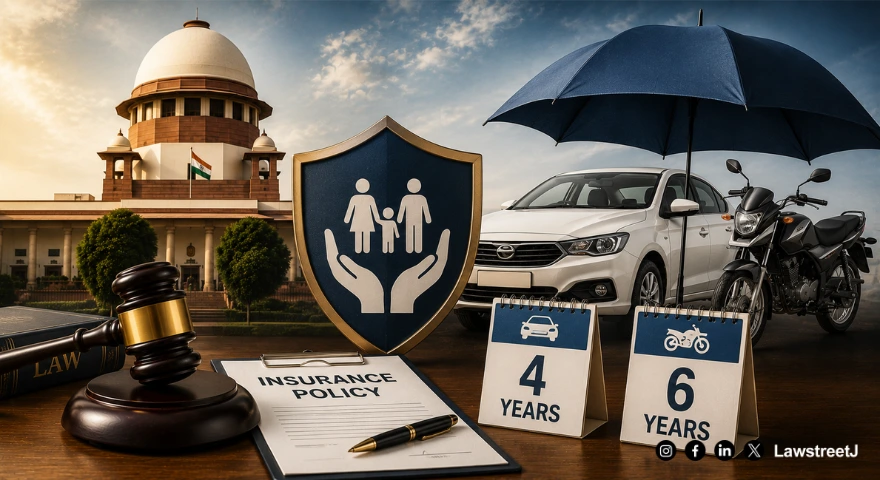
New Delhi: The Supreme Court has directed that third-party motor vehicle insurance be purchased for four years for new cars and six years for new two-wheelers, up from the earlier mandate of three and five years respectively, while issuing a series of technology-driven directions aimed at curbing the large number of uninsured vehicles plying on Indian roads.
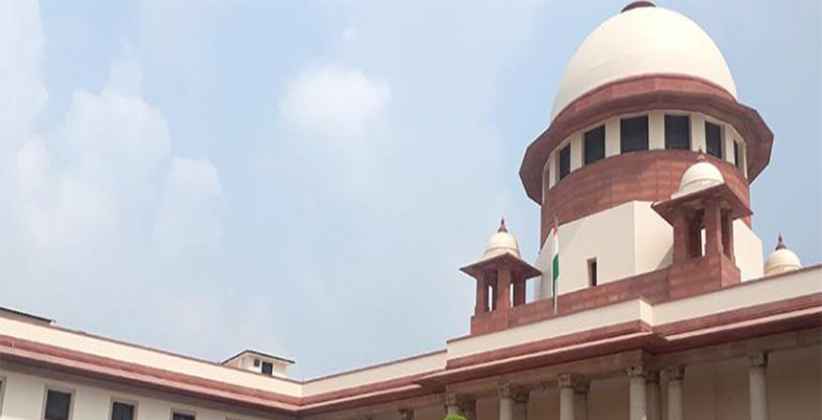
A Bench of Justices Sanjay Karol and Prashant Kumar Mishra was hearing an appeal filed by National Insurance Co. Ltd. against a Telangana High Court judgment that had held the insurer liable to compensate the family of a vehicle owner who died while travelling as a passenger in his own insured car. Noting that despite the statutory mandate under Section 146 of the Motor Vehicles Act, 1988, nearly 56% of vehicles on Indian roads amounting to 16.54 crore out of 30.48 crore vehicles remain uninsured, the Court proceeded to examine two larger issues concerning compliance with third-party insurance requirements and the need for a uniform motor-vehicle policy structure.
Having earlier impleaded twenty-two insurance companies, the Insurance Regulatory and Development Authority of India (IRDA), the General Insurance Council, and the Ministry of Road Transport and Highways, the Court examined affidavits filed by each of these stakeholders following consultations held pursuant to its order dated 09.12.2025.
On the technological measures, the Court directed that Automatic Number Plate Recognition (ANPR) cameras deployed on highways and roads be integrated with data from the Insurance Information Bureau and the VAHAN portal to enable automatic e-challans against uninsured vehicles. It further directed that State Police be equipped with handheld devices or downloadable applications linked to the same databases to verify insurance status and impose challans on the ground, and directed strict compliance once the pending amendment to Section 196 of the Act enhancing penalties for driving uninsured vehicles is notified.
Addressing the second issue, the Court accepted IRDA's proposal for a four-layer insurance structure for private vehicles: a mandatory Third-Party Only Policy as required under Section 146; an optional Legal Liability Cover for occupants and pillion riders; an optional Personal Accident Cover for the owner, driver and occupants; and an optional Own Damage Cover for the insured vehicle itself. Insurers were directed to issue a mandatory 'customer option form' at the point of purchase, allowing buyers to opt into the add-on covers, along with a consumer-friendly information sheet explaining the coverage.
The Court observed that although its 2018 direction in S. Rajaseekaran v. Union of India had already mandated third-party insurance for three years for new cars and five years for two-wheelers at the time of purchase, a large number of vehicles continued to remain uninsured eight years later, leading it to enhance the period further. The Bench held:
"Therefore, it is directed that henceforth, third-party insurance for four years for new cars and six years for new two wheelers be required to be purchased. IRDA to immediately issue necessary directions."
The Bench also directed a pilot project enabling citizens to verify a vehicle's insurance status, and asked IRDA and the Ministry to explore linking fuel supply to valid insurance status so that vehicles without valid insurance could be refused fuel until compliance as well as replacing toll-plaza stoppages with automatic detection through barrier-less tolling on identified highway corridors.
On the pendency of motor accident claims, the Court reiterated directions issued in General Insurance Council v. State of Andhra Pradesh and M.R. Krishna Murthi v. New India Assurance Company Limited, directing State Police to promptly file Detailed Accident Reports along with relevant documents before the Motor Accident Claims Tribunals in cases relating to accidents prior to 31.03.2022, and to assist in the prompt service and production of witnesses to ensure speedy disposal of such pending cases.
Grounding its directions in the constitutional guarantee of life under Article 21, the Court referred to its earlier ruling in In Re: Phalodi Accident v. National Highways Authority of India, observing that "no pecuniary or administrative constraint can outweigh the sanctity of human life."
Turning to the facts of the appeal itself, the Court upheld the Telangana High Court's finding that the insurance company was liable to compensate the family of Mr. T. Ramu, who died in 1996 after his insured Maruti 800 was struck from behind by a lorry near Singarayakonda while he was travelling in the vehicle as a passenger. The Tribunal had earlier denied compensation, holding that no extra premium had been paid to cover the owner's personal risk. Reversing this, the High Court had held that the policy was a comprehensive one covering the owner as well, and awarded Rs. 10,00,500/- with 7.5% interest per annum. Affirming this view, the Supreme Court held that insurers are liable to compensate any occupant of a vehicle under a comprehensive or package policy, in accordance with an IRDA circular dated 16.11.2009, and dismissed the appeal to that extent.
All stakeholders have been directed to file compliance affidavits by 14.08.2026, with the matter listed for further consideration on 18.08.2026.
Appearances:
Mr. N. Venkataraman and Mrs. Archana Pathak Dave, learned Additional Solicitors General, Mr. Joy Basu, learned Senior Counsel, and Ms. Meenakshi Midha and Mr. J.R. Midha, learned Senior Counsel, appeared and addressed the Court on behalf of the various stakeholders and parties.
Case Title: National Insurance Co. Ltd. vs. Smt. Thungala Dhana Laxmi & Ors., 2026 INSC 793, C.A. No. 14369 of 2025.