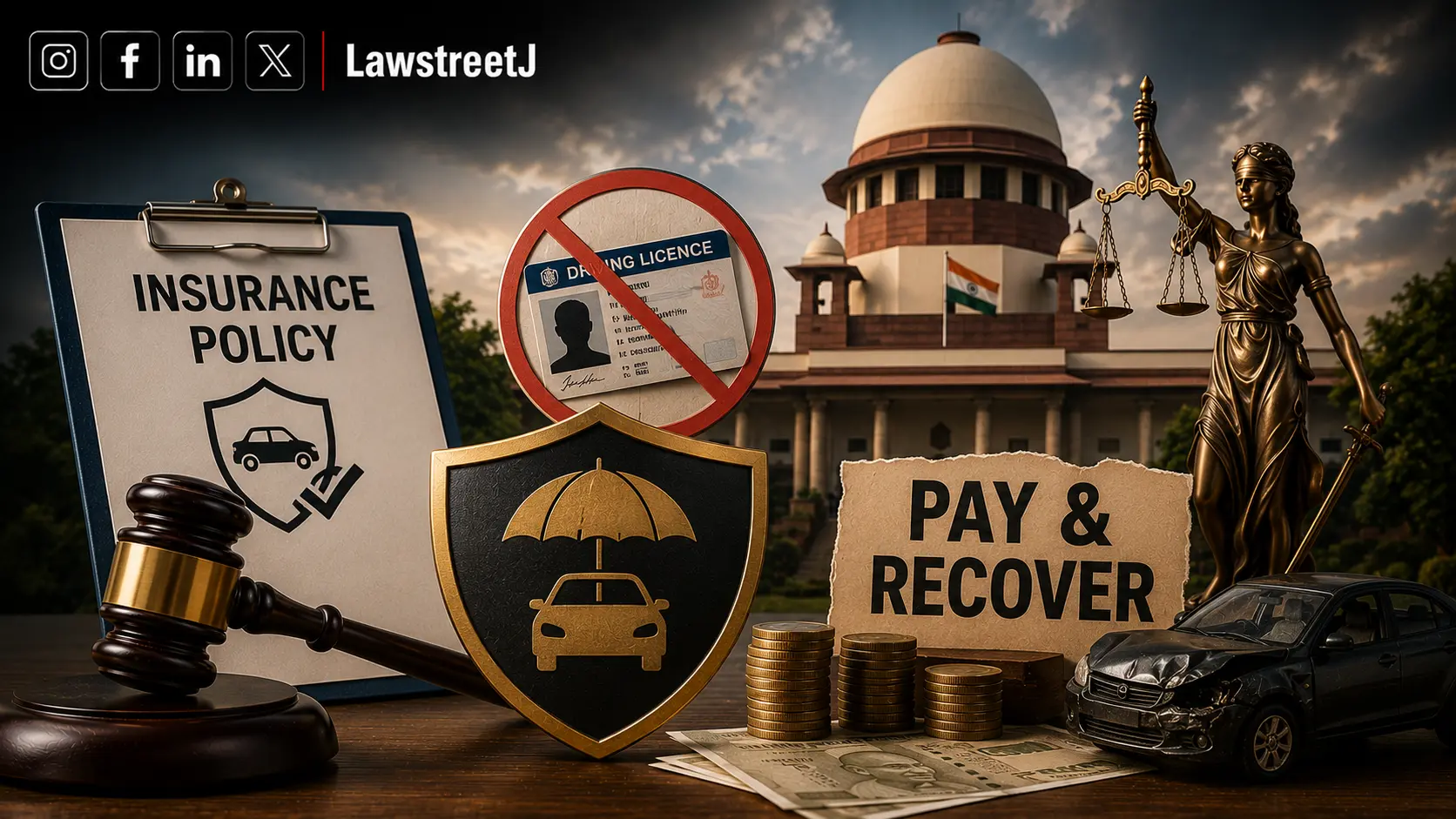
New Delhi: The Supreme Court has held that an insurance company cannot be fastened with liability to pay motor accident compensation where the driver of the offending vehicle did not possess a valid driving license at the time of the accident, and that in such circumstances, the ‘pay and recover’ principle would apply.
The Bench of Justice Sanjay Karol and Justice Nongmeikapam Kotiswar Singh set aside a judgment of the High Court of Punjab and Haryana which had reversed the finding of the Motor Accidents Claim Tribunal, Panipat, and fastened liability upon the insurer, holding that the driver's license stood renewed for the relevant period.
The accident occurred on 14th October 2009, when the offending vehicle hit a two-wheeler being driven by the claimant; rash and negligent driving was not in dispute. The Tribunal had held only the driver, Om Parkash, and the owner, Rajinder Singh, liable to pay Rs.86,95,947/- with 7.5% interest (escalating to 9% if unpaid within two months), on the ground that the driver did not hold a valid license on the date of the accident. On appeal, the High Court took the contrary view that the license had indeed been renewed and fastened liability of Rs.1,08,08,909/- with 8% interest upon the insurer instead.
The Tribunal had relied on the testimony of RW1 and RW2, officials of the Transport Department, who deposed that Om Parkash's license was not renewed for the period covering the date of the accident. It also noted a contradiction between the oral testimony of RW3, the Motor Licensing Officer, who claimed the license was valid from 22.06.2007 to 21.06.2010, and the documentary extract he himself produced (Ex.RW3/A), which did not support this claim. The High Court, however, placed reliance on a letter (Ex.RW3/B) produced by the driver, in which the licensing office attributed the missing records for 2007-2010 to a technical error during data transfer between agencies, and on RW3's oral assurance that the license had continued to be valid throughout.
The limited question before the Supreme Court was whether Om Parkash possessed a valid driving license on the date of the accident. The Court noted that under Section 3 of the Motor Vehicles Act, no person may drive a vehicle without an effective license, and under Section 5, an owner may not permit a person to drive who does not meet this requirement.
On the question of proof of official documents, the Court traced the law on secondary evidence under Sections 61 to 65 of the Indian Evidence Act, 1872, referring to the Constitution Bench decision in ‘Neeraj Dutta v. State (NCT of Delhi)’ and the recent ruling in ‘Tharammel Peethambaran v. T. Ushakrishnan’, which had summarised that secondary evidence is admissible only once a party has laid the foundation for the original's non-production, and that mere marking of a document as an exhibit does not dispense with the requirement of proving it in accordance with law.
Applying these principles, the Court found that the licensing officer had not produced any official record documenting the alleged loss of data or the steps taken to recover it, and that the letter relied upon by the High Court, being an unproven communication produced by the driver himself, could not outweigh the documentary extract (Ex.RW3/A) that contradicted RW3's own oral testimony – a contradiction the High Court had not even addressed. The Court also noted that RW3, in cross-examination, had confirmed that a penalty had been charged for the very period during which the license was claimed to be continuously valid, a fact only the Tribunal had taken to its logical conclusion.
The Court referred to its recent decision in ‘Telangana State Level Police Recruitment Board v. Penjarla Vijay Kumar’, on the significance of a valid license and the effect of delayed renewal:
“32… It cannot be lost sight of or denied that driving is not merely a qualification on paper but also involves hands-on experience coupled with regular practice… 33. …The theory that once a licence is renewed, even after a gap, the renewal would operate from a back date implying that the licence was continuing and valid even for and during the interregnum cannot be countenanced…”
On the consequence for the insurer's liability, the Court relied on the three-judge bench ruling in ‘Beli Ram v. Rajinder Kumar’, which had held that an owner cannot escape responsibility for verifying that a driver's license remains renewed, particularly where the lapse runs into years rather than a short gap:
“14. We are of the view that once the basic care of verifying the driving licence has to be taken by the employer, though a detailed enquiry may not be necessary, the owner of the vehicle would know the validity of the driving licence as is set out in the licence itself. It cannot be said that thereafter he can wash his hands off the responsibility of not checking up whether the driver has renewed the licence…”
The Court also noted that the owner, Rajinder Singh, had not entered the witness box to depose either that the driver held a valid license on the date of the accident or that he had taken steps to ensure the license was renewed after expiry.
Accordingly, the Supreme Court allowed the appeal, holding the appellant-insurer not liable to make good the award, with the final burden resting on the driver and owner. Since the compensation amount had already been directed to be released to the claimants pursuant to the Court's earlier order issuing notice, it held the principle of ‘pay and recover’ to be applicable, leaving the insurer at liberty to recover the amount from the driver and owner in accordance with law.
The Court further observed that the burden of such awards falling upon drivers and owners for want of a renewed license could ‘throw into disarray their entire lives’, and urged the Ministry of Road Transport and Highways and State counterparts to undertake awareness campaigns on the importance of valid licenses, introduce measures for strict compliance, and streamline the process of issuance and renewal of licenses, along with addressing the regulation, affordability, and regional-language accessibility of driving schools and tests.
Case Title: Reliance General Insurance Company Ltd. v. Om Parkash & Ors., Arising out of SLP(C) Nos.6743-6744 of 2023



.jpeg)