New Delhi: The Supreme Court addressed significant questions during the week of November 9–14, 2026, concerning compensation for victims of cyber fraud, deemed suspension of public servants, inheritance rights under Hindu succession law, and environmental protection against illegal mining and industrial pollution. The following four rulings are notable for their legal principles and potential impact on future litigation.
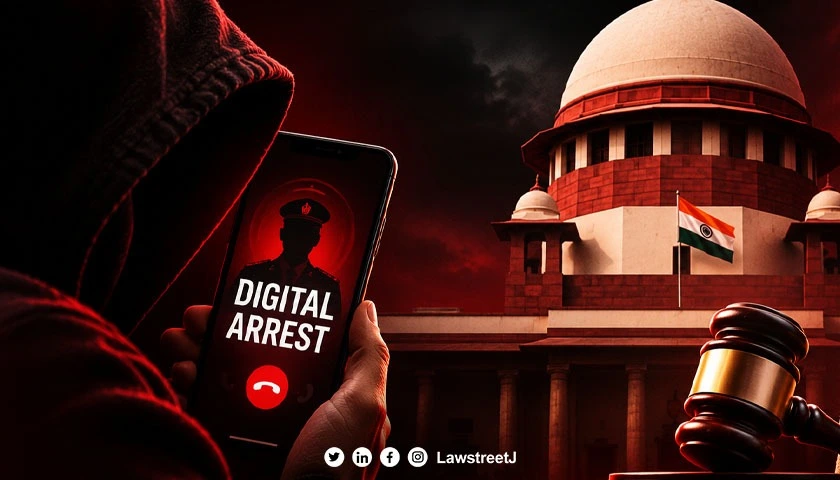
Digital Arrest Scam Victims Must Get Compensation Equal to Loss if Banks Fail Due Diligence: SC
The Supreme Court emphasised that the Reserve Bank of India's proposed Know Your Customer (KYC) amendments must provide for financial institutions to indemnify victims of digital arrest scams and other cyber frauds where the loss results from the institution's failure to exercise due diligence in preventing or reporting the fraud. A Bench comprising Chief Justice of India Surya Kant, Justice Joymalya Bagchi and Justice V. Mohana observed that compensation should be not less than the amount lost by the customer in such circumstances. The Court also recalled preventive safeguards, including temporarily suspending suspicious transactions inconsistent with an account's usual pattern, informing the nearest police station and physically verifying reported transactions. It directed the RBI to submit a list of authorised financial institutions and called upon State and Union Territory law enforcement agencies to report the status of registered FIRs and investigations. The Court, however, has not yet issued final directions on compensation and will examine the proposed RBI amendments before proceeding further. Read Full Article
Public Servant Deemed Suspended After 48 Hours in Judicial Custody: SC
The Supreme Court restored the regular bail granted to a hospital manager accused of demanding a ₹4,000 bribe for clearing a complainant's pending wages, setting aside the Patna High Court's order cancelling his bail nearly a year after its grant. A Bench of Justices J.B. Pardiwala and Manmohan observed that, having regard to the maximum punishment and the circumstances of the case, bail would ordinarily be appropriate unless there were criminal antecedents or exceptionally grave facts. The Court also highlighted that a public servant who remains in judicial custody for more than 48 hours is deemed to have been placed under suspension, without requiring a separate suspension order. Taking note that the appellant had been reinstated and posted in the same hospital despite having remained in judicial custody for approximately 15 days, the Court expected the Bihar Government to examine the matter and take appropriate action in accordance with law. The Court clarified that its order did not examine the merits of the corruption allegation, which remains subject to trial. Read Full Article
Grandson Has No Birthright in Property Father Inherited Under Section 8 HSA: SC
The Supreme Court held that a grandson cannot claim a right by birth in property inherited by his father under Section 8 of the Hindu Succession Act, 1956, as such property is held by the father in his individual capacity and does not automatically become ancestral or coparcenary property in the hands of his branch. A Bench of Justices Sunita Agarwal and Augustine George Masih dismissed a partition suit filed by a minor grandson claiming a share in property that had devolved upon his father following a partition of the grandfather's estate. Relying on earlier decisions, including Commissioner of Wealth Tax v. Chander Sen and Yudhishter v. Ashok Kumar, the Court reiterated that property inherited by a son under Section 8 is not held by him as the Karta of his own Hindu Undivided Family. It further clarified that the provisions concerning coparcenary rights under Section 6 of the 1956 Act and Section 29-A of the Tamil Nadu Amendment Act were not attracted in the circumstances of the case. The judgment reinforces the distinction between ancestral coparcenary property and property devolving through statutory succession. Read Full Article
SC Bars New Industries Near Rajasthan Rivers, Orders SIT Probe Into Illegal Mining
The Supreme Court restrained the Rajasthan Government from granting permissions for new industrial units along or near the Luni, Jojari and Bandi rivers until the High Flood Line and buffer zones are scientifically determined. A Bench of Justices Vikram Nath and Sandeep Mehta also directed the constitution of a Special Investigation Team headed by an officer not below the rank of Inspector General of Police to investigate organised illegal bajri mining in the region. The Court expressed concern over attempts to alter recorded river widths on the basis of sewage and treated wastewater flows, observing that such an exercise could drastically reduce the recognised river corridors. It further deprecated the Mining Department's grant of leases in areas where illegal mining had previously been detected, cautioning against the post facto regularisation of illegal activities. The Court directed the State to maintain an additional 100-metre protective zone and prohibited Red Category industries within 500 metres of the recorded outer boundaries of the rivers, emphasising that environmental compliance must result in effective protection on the ground rather than merely administrative action. Read Full Article