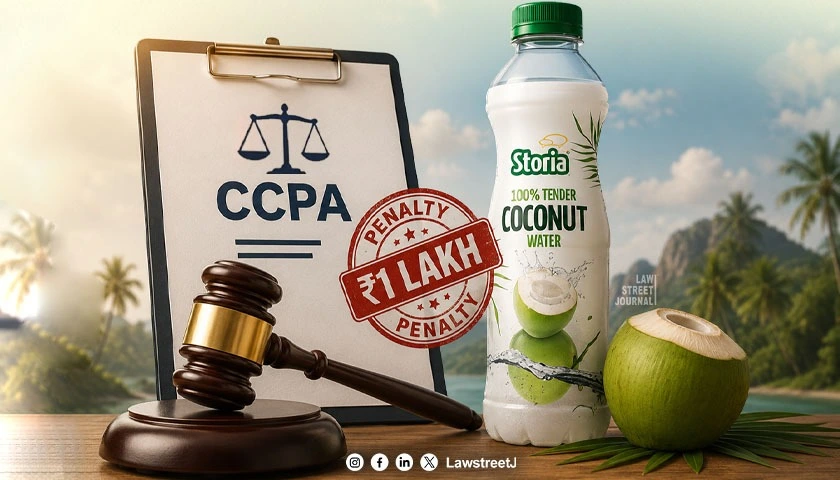
The Central Consumer Protection Authority found that Storia Foods misled consumers by marketing reconstituted coconut water concentrate as "100% Natural Tender Coconut Water" and fruit beverages with as little as 4% fruit content as "100% Juice", and directed immediate discontinuation of all impugned claims across its website, product packaging and e-commerce listings.
The Central Consumer Protection Authority (CCPA) has imposed a penalty of ₹1,00,000 on M/s Storia Foods and Beverages Private Limited for engaging in misleading advertisement and unfair trade practice in connection with its coconut water and fruit juice products.
The order, dated June 18, 2026, directs Storia to immediately discontinue the claims “100% Tender Coconut Water” and “100% Natural Tender Coconut Water” as well as the claim “100% Juice” on its Pomegranate, Mixed Fruit, Mango and Guava Chilli variants across its official website, product packaging and all e-commerce listings, and to submit a compliance report within fifteen days.
Background
The CCPA, took up the matter suo motu after observing that Storia prominently advertised its coconut water product as “100% Tender Coconut Water” and “100% Natural Tender Coconut Water” on its official website, on the front of its product packaging, and across major e-commerce platforms. However, the ingredient declaration on the product label disclosed the actual composition as “Water and Coconut Water Concentrate (9.6%) (Equivalent to 100% Coconut Water)(Reconstituted)”.
Similarly, the CCPA observed that Storia’s Pomegranate, Mixed Fruit, Mango and Guava Chilli variants were advertised as “100% Juice”, although the respective ingredient panels disclosed compositions consisting predominantly of water with fruit pulp or concentrate ranging between only 4% and 16%, with the remainder comprising apple juice concentrate and water. The CCPA also noted that Storia’s promotional material attributed health and therapeutic benefits to its coconut water product, including “Combats Virus”, “Improves Metabolism”, “Kills Fatigue” and “Rehydrates the Body Faster than Water”, without any product-specific scientific substantiation placed on record.
The CCPA issued a Show Cause Notice and Storia filed a reply contending that its products were permissible under the Food Safety and Standards (Food Products Standards and Food Additives) Regulations, 2011, that the reconstituted nature of the product was disclosed through the ingredient declaration, and that the health-related claims were supported by peer-reviewed scientific literature on the general properties of coconut water. The matter was referred to the Director General (Investigation), whose report upheld the allegations of misleading advertisement and unfair trade practice across all five products. Storia was thereafter afforded a further opportunity to appear and make submissions, and was heard on June 11, 2026.
Arguments
Storia’s legal counsel and Head of Research and Development appeared at the hearing on June 11, 2026. Storia submitted that the Investigation Report conflated two distinct products: a non-reconstituted, single-ingredient coconut water and the reconstituted “Storia 100% Tender Coconut Water” which was the subject of the proceedings. Storia contended that Regulation 2.3.6 of the FSS Standards Regulations recognises reconstitution to single strength as a valid manufacturing process, that a product so reconstituted is treated as equivalent to fruit juice obtained directly from the fruit, and that its use of the term “natural” was consistent with Regulation 9(2) read with Schedule V of the Food Safety and Standards (Advertising and Claims) Regulations, 2018 since no foreign substances or synthetic additives were added.
Storia further argued that the “(Reconstituted)” declaration on the label complied with minimum font-size requirements under Regulation 6(3) of the FSS Labelling and Display Regulations and that the FSSAI’s Extension Letter dated January 10, 2025 had permitted it to utilise pre-printed packaging bearing the “100%” claim for products manufactured on or before March 31, 2025, which it contended rendered the continued presence of such products in the market in October 2025 consistent with regulatory authorisation. With respect to the sugarcane juice product bearing the claim “100% Sugarcane”, which was flagged in the Investigation Report, Storia argued that this finding exceeded the scope of the Show Cause Notice and that the product was no longer being sold through any active retail channel. Storia also contended that the health-related claims were supported by published, peer-reviewed literature on the general properties of coconut water, and noted that the “Combats Virus” claim had been voluntarily discontinued in December 2023.
Analysis
The CCPA rejected Storia’s regulatory defence in its entirety. On the coconut water claim, the Authority held that Regulation 2.3.6 of the FSS Standards Regulations governs Thermally Processed Fruit Juices and does not extend to coconut water, which is not a fruit juice extracted by mechanical process from the flesh of a fruit. Even assuming the regulation applied, it permits the reconstitution process but does not authorise a manufacturer to describe a reconstituted product as “100%” of the original natural product or to suppress its reconstituted nature. The CCPA further found that Regulations 5(1)(a) and 5(1)(b) of the FSS Labelling Regulations, which the company invoked in its defence, provided no support, since no compositional standard under those regulations authorises the name “100% Tender Coconut Water” for a reconstituted product. Regulation 4(3) of the FSS Labelling Regulations was found to independently prohibit the impugned front-of-pack description as false, misleading and deceptive.
On the defence that FSS framework compliance amounts to a safe harbour under the Consumer Protection Act, the CCPA held, relying on Section 100 of the Act, that the CCPA’s jurisdiction under Sections 10, 18 and 21 operates independently of and cumulatively with FSSAI’s regulatory framework. FSS compliance is a relevant consideration under Paragraph 4(g) of the 2022 Guidelines but does not displace the distinct question of whether an advertisement is likely to mislead an ordinary consumer as to the nature, composition or quality of the product.
On the back-of-pack disclaimer, the CCPA held that the technical parenthetical “(Equivalent to 100% Coconut Water)(Reconstituted)” buried in the ingredient declaration in a disproportionately small font does precisely what Clause 11(1) of the 2022 Guidelines forbids: it attempts to correct and qualify an inherently misleading front-of-pack claim while being presented in a manner wholly incommensurate with the prominence of the principal claim. The Authority also found that Storia’s defence that the “natural” claim was permissible under Schedule V of the FSS Advertising and Claims Regulations was unavailable since the product itself contained Class II Preservative INS 202, which the company admitted at the hearing, and the conditions prescribed under Schedule V for making a “natural” claim expressly require that the product be free from added chemicals and preservatives.
On the “100% Juice” claims, the CCPA found that a product containing as little as 4% fruit pulp or concentrate dissolved in water cannot truthfully claim to belong to the highest tier of the regulatory hierarchy for fruit-based beverages. A further infirmity was identified in the Pomegranate and Mixed Fruit variants, where Apple Juice Concentrate is present in equal or greater proportion than the named characterising fruit, rendering the product name itself a false description of the product within the meaning of Section 2(28)(i) of the Act.
On the health claims, the CCPA found that reliance on generalised literature concerning the properties of coconut water as a category does not substantiate a specific representation that Storia’s branded product confers stated benefits. The cited passage from Tuyekar et al. (2021) relied upon for the “Kills Fatigue” claim contained no reference to antithrombotic activity, blood flow or clot formation. The Kuberski et al. (1979) study relied upon for the “Rehydrates the Body Faster than Water” claim expressly noted that coconut water was deficient in sodium, chloride and bicarbonate relative to established rehydration standards, directly undermining rather than supporting the claim. The “Improves Metabolism” claim was found to rest on a generalised statement about human metabolic biochemistry, not a finding regarding consumption of Storia’s product. On the “Combats Virus” claim, the CCPA rejected Storia’s submission that the claim had been discontinued since December 2023, noting that the claim was live on the company’s official website as late as September 2024 as evidenced by a screenshot forming part of the Show Cause Notice itself, and remained wholly unsubstantiated.
Conclusion
The CCPA found Storia to have falsely described its coconut water product through the unqualified claims “100% Tender Coconut Water” and “100% Natural Tender Coconut Water” in violation of Section 2(28) of the Act; to have made the health and therapeutic claims without adequate scientific substantiation in violation of the Act; and to have created a misleading impression as to the composition of its Pomegranate, Mixed Fruit, Mango and Guava Chilli variants through the prominent claim “100% Juice” in violation of Sections 2(28)(i) and 2(28)(ii) of the Act. The foregoing representations were further held to constitute unfair trade practice under Section 2(47) and to have compromised the consumer’s right to be accurately informed under Section 2(9) of the Act.
Under Sections 20 and 21 read with Section 10 of the Consumer Protection Act, 2019, the CCPA directed Storia to, with immediate effect, discontinue the claims “100% Tender Coconut Water” and “100% Natural Tender Coconut Water” on its website, product packaging and all e-commerce listings; to discontinue the claim “100% Juice” on its Pomegranate, Mixed Fruit, Mango and Guava Chilli variants on its website and all e-commerce listings; to discontinue the health claims “Combats Virus”, “Improves Metabolism”, “Kills Fatigue” and “Rehydrates the Body Faster than Water” on its website, product packaging and all e-commerce listings, and not to attribute any health or therapeutic benefit to its products in future advertisements unless such claim is supported by scientific substantiation specific to the product so advertised; and to pay a penalty of ₹1,00,000 within fifteen days of receipt of the order.
Storia was also directed to submit a compliance report in respect of all directions within fifteen days.
Case Title: In the matter of Misleading advertisement and unfair trade practice by M/s Storia Foods and Beverages Private Limited (Case No. CCPA-2/71/2024-CCPA)


![CCPA Imposes ₹7 Lakh Penalty on Vajiram & Ravi for Misleading UPSC Result Advertisements [Read Order]](/secure/uploads/2026/06/lj_7667_UPSC.webp)
![CCPA Slams PhysicsWallah With Rs 5 Lakh Fine for Dark Patterns [Read Order]](/secure/uploads/2026/06/lj_6140_CCPA_Slams_PhysicsWallah_With.webp)
![Lawyer Gets Rs 15,000 Compensation After Restaurant Charges Rs 151 Service Fee Without Consent [Read Order]](/secure/uploads/2026/06/lj_3169_Lawyer_Gets_Rs_15000_Compensation.webp)