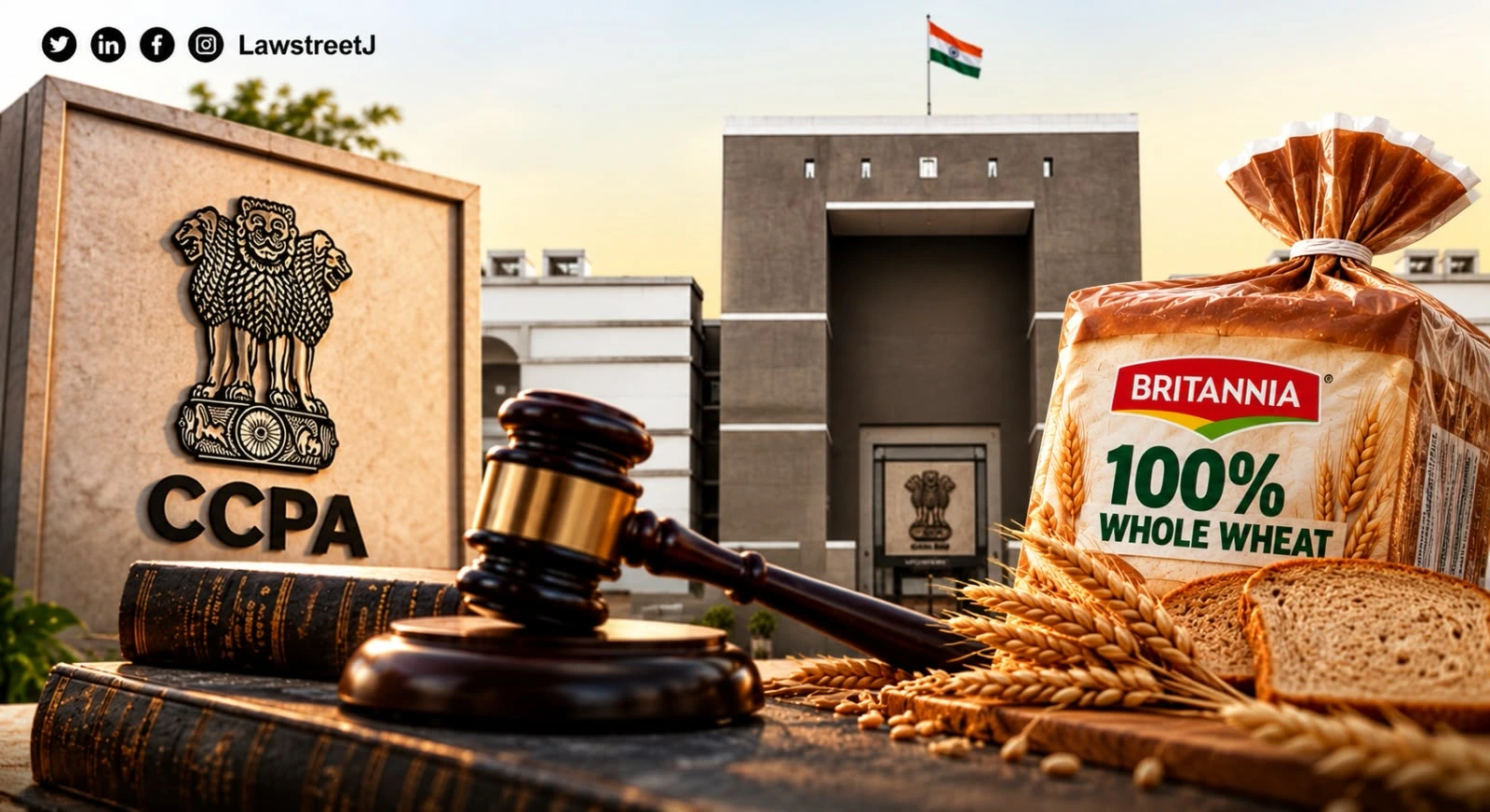
New Delhi: The Central Consumer Protection Authority (CCPA) has held that Britannia Industries Ltd.’s “100% Whole Wheat Bread” claim, made for a product declaring only 62% wheat flour, is a misleading advertisement and an unfair trade practice under the Consumer Protection Act, 2019.
By its order dated 22.10.2026, the Authority directed the company to discontinue the claim across print, electronic and social media, imposed a penalty of Rs. 1,00,000 and called for a compliance report within 15 days.
The order was passed by Chief Commissioner Nidhi Khare and Commissioner Anupam Mishra in a suo motu proceeding. The CCPA noted that the packaging declared wheat flour (atta) at 62%, whereas Regulation 2.6 of the Food Safety and Standards (Labelling and Display) Second Amendment Regulations, 2022 requires whole wheat flour of at least 75% for a bread to be named “Whole Wheat Bread”. A preliminary inquiry led to a notice dated 13.01.2025, and the matter was referred to the Director General (Investigation) on 07.02.2025.
The DG’s report dated 07.09.2026 recorded the FSSAI’s view that the term “100%” is not permissible under the FSS (Advertising and Claims) Regulations, 2018, and that its Advisory dated 28.05.2025 asked food businesses to drop it. An Improvement Notice was served on the company on 30.07.2026. The CCPA noted that the claim nonetheless remained on the company’s website and promotional channels. Of the six claims initially examined, three were dropped; the remaining three, each carrying the “100%” prefix, were examined on merits.
Britannia’s counsel, Sandeep Kumar, Mohd Mohsin Beg, Tahir Nizam and S. Siddharth Jain, argued that “100%” only signified unadulterated wheat with no maida, that on a flour basis the product is 100% whole wheat flour, and that the FSSAI Advisory is advisory and not mandatory. The company also relied on a “#” qualifier reading “Made From 100% Whole Wheat Flour. On Flour Basis”.
Rejecting this, the CCPA held that the test is not the manufacturer’s subjective intent but the understanding of an average consumer of ordinary prudence. It observed that “the expression ‘100%’ conveys totality of composition and not selective exclusivity of a single category of ingredient.” It added that the absence of an explicit stipulation of “100%” wheat flour for “Whole Wheat Bread” “does not imply that exaggerated or absolute claims are permissible.”
On the disclaimer, the Authority held that the front-of-pack “100%” and the “62%” in the ingredient list on the reverse could not be reconciled by an ordinary consumer, and that a much smaller-font qualifier “cannot cure, neutralize or override” the prominent claim. It relied on Clause 11(2) of the Guidelines for Prevention of Misleading Advertisements and Endorsements for Misleading Advertisements, 2022, which requires a disclaimer to be in the same font as the claim and clearly visible to a normally-sighted person. The company’s reasoning, the CCPA said, would permit a product with just 5% atta and no maida to be sold as “100% Atta Bread”.
The Authority found the representation misleading on two independent counts: it falsely described the product as 100% whole wheat when the content was 62%, and it used the nomenclature “Whole Wheat” although the 75% threshold was not met. The “0% Maida” claim, read alongside, only reinforced the impression of a product wholly of whole wheat flour. The conduct fell within the definition of “misleading advertisement” in Section 2(28) and of “unfair trade practice” in Section 2(47)(a) and (d) of the Act.
The CCPA also examined the claim that the bread “pairs perfectly well with a healthy diet”. Read with the packaging statement that the fibre in three slices equals that in one roti, it conveyed an implied representation of nutritional equivalence to a traditionally prepared wheat roti, amounting to a false representation about the usefulness of the goods. Underlining the shift from caveat emptor to caveat venditor under the 2019 Act, the Authority also took note of the company’s scale: 20 owned factories, over 400 distributors and about 26 lakh retail outlets.
Invoking Sections 10, 18, 20 and 21 of the Act, the CCPA directed Britannia to discontinue the advertisements with immediate effect, pay Rs. 1,00,000 for misleading advertisement and unfair trade practice, and file a compliance report within 15 days.
Appearances:
For the Opposite Party (Britannia Industries Ltd.): Mr. Sandeep Kumar, Mr. Mohd Mohsin Beg, Mr. Tahir Nizam and Mr. S. Siddharth Jain.
Case Title: In Re: Britannia Industries Ltd., F.No. CCPA-2/1/2025-CCPA [E-36391]