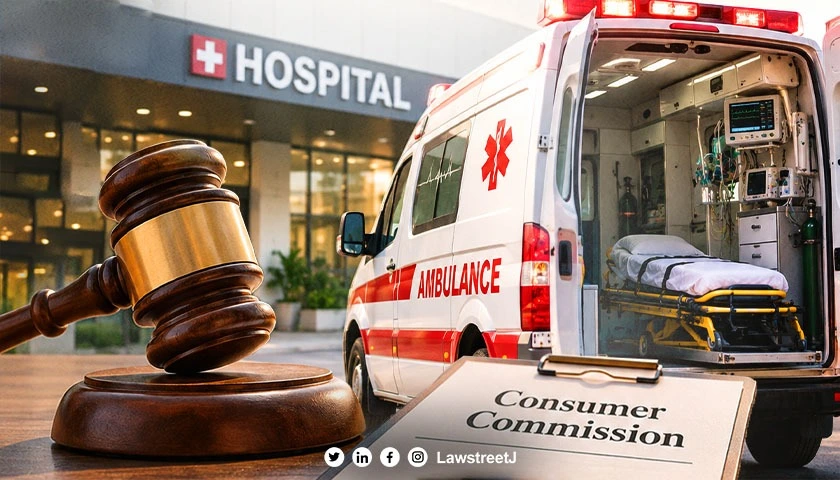
New Delhi: The Delhi State Consumer Disputes Redressal Commission has ordered Metro Hospital & Heart Institute, Lajpat Nagar, to pay ₹15 lakh as compensation to a patient who developed a stroke after treatment for a blocked heart valve, holding it deficient in service for failing to provide a life-support ambulance and an accompanying doctor when he was shifted to another hospital.
The Commission, however, found no medical negligence by the treating cardiologist or in the treatment itself. The complaint, filed in 2015, was partly allowed by a Bench of President Justice Sangita Dhingra Sehgal and Member (Judicial) Ms. Pinki on 6 November 2026.
The complaint (CC/1146/2015) was filed by Suresh Kumar, through his wife, against Metro Hospital and its doctor, claiming ₹35 lakh for medical negligence and mental agony, ₹50 lakh for loss of future earnings and expenses, and litigation costs. The patient, who had undergone dual valve replacement at AIIMS in 2008, was rushed to the hospital’s emergency on 13.11.2013 with acute breathing difficulty, where an echo showed an obstructed aortic prosthesis with thrombus. He was admitted on the doctor’s advice, and the cost of the procedure was quoted at ₹30,000.
The complainant alleged that the family was told only that an injection would be given, that the risks were not explained, and that on 15.11.2013 the right side of the patient’s body became semi-paralytic, which was conveyed by a nurse and not by the doctor. He alleged that the hospital asked the family to shift him to its Noida facility but then said that no fully equipped ambulance was available and that the accompanying doctor was “busy somewhere”, and that the attendants had to arrange an ambulance from Vimhans Hospital, with no doctor accompanying the patient. He said that the patient has since suffered loss of speech, memory and mental ability and cannot earn a livelihood.
The hospital denied negligence, saying that the complainant produced no expert opinion, that three independent experts found no negligence, that thrombolysis with streptokinase was done on the basis of a written high-risk consent, and that the attendants were offered a shift to its Noida hospital but did not consent. The doctor was proceeded against ex parte on 21.07.2016.
The Commission, noting that consumer fora are not experts in medicine, relied on the Supreme Court’s decision in Martin F. D’Souza v. Mohd. Ishfaq, and sought an opinion from the Expert Medical Board at G.B. Pant Hospital. The Board said that thrombolytic therapy with streptokinase is an established line of management for a stuck valve, that high-risk consent was taken, that dislodgement of the thrombus causing stroke is a known complication, and that the doctor was informed immediately after the stroke and the attendants were given the choice of referral. It said that it could not comment on the differences in the versions on the logistics of transfer.
The Commission also noted the order of the Delhi Medical Council of 28.11.2017, which found that the patient’s valve thrombosis was successfully managed with streptokinase thrombolysis, that the stroke was a known complication, and that prima facie no case of medical negligence was made out against the doctor, as well as the Medical Council of India’s decision of 15.11.2019 upholding it. It concluded that the patient was managed as per standard protocol, and that no medical negligence could be attributed to the treating doctor.
Turning to the hospital, the Commission held that it was apparent from the record that it failed to provide an ambulance for transferring the patient, and that a premier hospital creates a legitimate expectation of a superior standard of care. It held that providing basic emergency facilities, including an appropriately equipped ambulance and qualified personnel for transfer, cannot be treated as “an optional or dispensable service”, and that a hospital’s duty continues during the transfer of a patient to another facility.
The Commission found that the hospital had maintained complete silence on the issue and furnished no plausible explanation or material to show reasonable arrangements for the transfer, though the facts were within its exclusive knowledge. It said that the failure was a serious dereliction of the duty of care and amounted to deficiency in service under the Consumer Protection Act, 1986.
The Commission partly allowed the complaint against the hospital and directed it to pay ₹15,00,000 as compensation for the mental agony and distress caused to the patient and attendants by failing to provide a life support ambulance and putting the patient’s life at risk, and ₹50,000 as litigation costs. The amount is to be paid by 06.01.2027, failing which it will carry interest at 9% per annum from the date of filing of the complaint until realisation.
Appearances: For the Complainant: Ms. Charu Sachdeva, Advocate. For Opposite Party No. 1 (Metro Hospital & Heart Institute): Sh. Pradeep Kar, Advocate. Opposite Party No. 2 (the doctor) was proceeded against ex parte.
Case Title: Suresh Kumar v. Metro Hospital & Heart Institute and Others, Complaint Case No. 1146/2015