The District Consumer Disputes Redressal Commission, Jalandhar, has held a city restaurant liable for unfair trade practice for levying service charges on a customer without his consent, directing it to refund the amount and pay compensation for the mental harassment caused.
The Commission, comprising Dr. Harveen Bhardwaj, President, along with Members Smt. Jyotsna and Sh. Jaswant Singh Dhillon, was hearing a complaint filed by Sanjeev Duggal, a practising advocate at Jalandhar, against Maya Inns Pvt. Ltd. and its Managing Director.
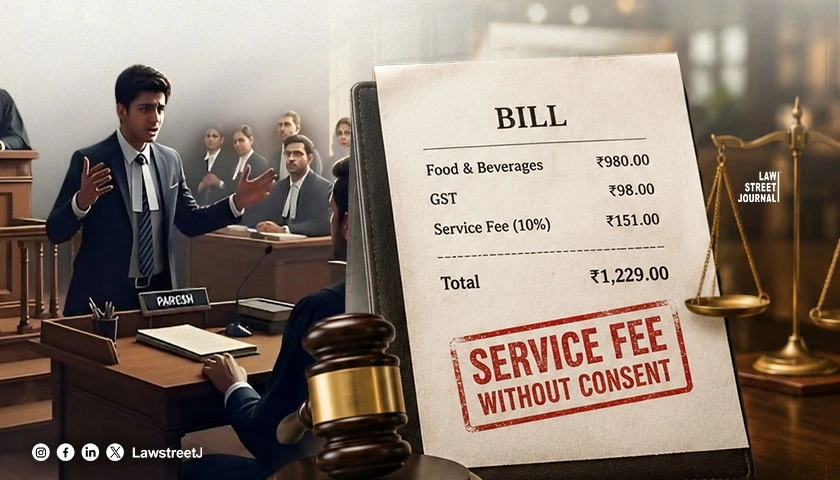
According to the complainant, he visited the restaurant of the opposite parties for a buffet dinner. He claimed he had specifically informed the staff of the composition of his party, but was nevertheless charged buffet rates for four adults. He also purchased liquor during the visit. Two bills were issued, in which service charges of Rs 128.13 and Rs 23.40, levied at the rate of 3 per cent, were added, totalling Rs 151.53. The complainant alleged that when he objected to the levy of these charges and to being billed for an extra adult, the restaurant staff misbehaved with him and failed to redress his grievance. He further alleged that the quality of certain food items, particularly the fish served, was unsatisfactory. Citing deficiency in service, unfair trade practice, mental agony, harassment and humiliation, he sought a refund of the service charges along with compensation of Rs 5,00,000 and litigation costs.
The opposite parties contested the complaint, denying any misbehaviour, deficiency in service or unfair trade practice, and described the complaint as misconceived and filed with mala fide intent. They submitted that the amount in question was charged as staff contribution or service charge, that this was prominently displayed on the menu card, and that their policy was to waive the charge if any customer objected. They maintained that the complainant never raised any objection at the relevant time. The opposite parties also relied on interim orders passed by the Delhi High Court in proceedings concerning service charges levied by hotels and restaurants. While denying liability, they expressed willingness to refund the total sum of Rs 151.53 reflected in the two bills.
Both parties led evidence in support of their respective versions. The complainant proved the two bills on record as Ex.C1 and Ex.C2, while the opposite parties produced the restaurant’s menu card as Ex.OP-2.
Examining whether the levy of the disputed charges amounted to deficiency of service or unfair trade practice, the Commission noted that the opposite parties, by admitting the charge and offering to refund it, had effectively conceded that the amount was levied. The opposite parties had argued that, pursuant to a Delhi High Court order dated 5 September 2023 and Central Consumer Protection Authority guidelines dated 4 July 2022, the terminology had since been changed from “service charge” to “staff contribution.” The Commission held that even if this changed terminology was used, a restaurant was still obliged to disclose to its customers, clearly and in advance, that such a charge would be levied. It found nothing on record, either in the pleadings or the bills themselves, to show that the complainant had been informed of any such charge beforehand. The bills, in fact, described the levy as “service charge” and not “staff contribution,” and the opposite parties led no evidence that the complainant had ever consented to its mandatory payment.
On the allegations of misbehaviour, sub-standard food and being billed for a minor as an adult, the Commission found these unsubstantiated. It observed that there was “no evidence on the record to substantiate the allegations of misbehavior,” noting that the complainant, himself an advocate familiar with the appropriate course of action, had neither examined an independent witness nor lodged a complaint with the restaurant’s higher management, the food safety authorities, or any other body at the relevant time. The Commission held that such allegations would require evidence tested through cross-examination, and that the complainant remained free to pursue any other legal remedy available to him in that regard.
On the charge itself, however, the Commission concluded that the opposite parties had levied a service charge rather than a staff contribution “without obtaining consent from the consumer,” which amounted to an unfair trade practice entitling the complainant to a refund along with compensation for the mental harassment suffered.
The complaint was accordingly partly allowed. The Commission directed the opposite parties to refund Rs 151.53 charged as service charge, along with a sum of Rs 15,000 as compensation, inclusive of litigation expenses, for the mental tension and harassment caused to the complainant. Compliance was directed to be completed within 45 days from receipt of a copy of the order.
Case Title: Sanjeev Duggal v. Maya Inns Pvt. Ltd. [Complaint No. 469 of 2023]



![Gujarat HC Upholds Compensation Award For Electrocution Death Caused By Electric Board’s Negligence [Read Judgment]](/secure/uploads/2025/07/lj_7246_Gujarat_HC_Upholds.webp)