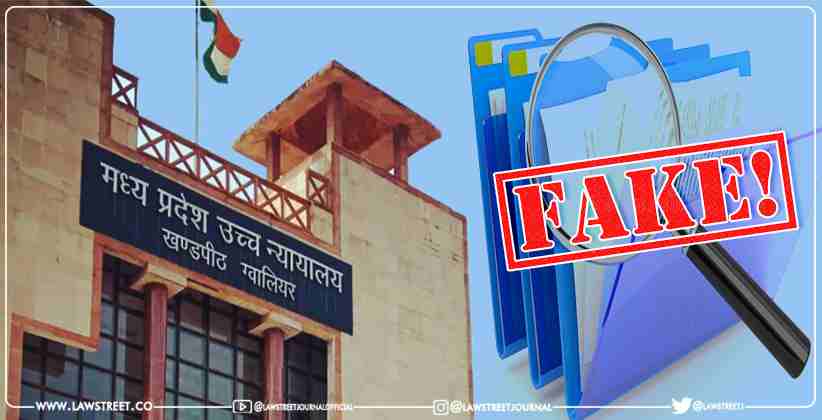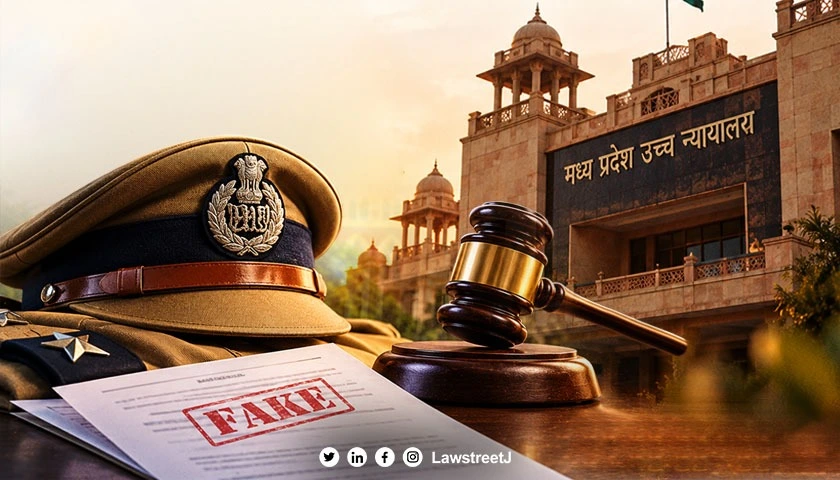
Jabalpur: The Madhya Pradesh High Court has quashed the summary dismissal of an Acting Sub-Inspector, passed a day after a woman cleaner complained against him, holding that the dismissal order merely repeated the words of Article 311(2)(b) of the Constitution without giving reasons why a departmental inquiry was not reasonably practicable. The Court also noted that the State’s reply relied on a case that does not exist and cautioned against the use of Artificial Intelligence tools without verification.
Justice Vivek Kumar Singh was hearing a writ petition by Piyush Mani Tiwari, who joined the police as a Constable on 02.12.1992 and was working as an Acting Sub-Inspector at the State Situation Room, Special Branch, Police Headquarters, Bhopal, in May 2024. He challenged the order of 27.05.2024 dismissing him under Article 311(1) read with 311(2)(b) and 311(3) and Clause 222(c) of the M.P. Police Regulations, and the appellate order of 22.07.2024.
On 26.05.2024 a private woman cleaner posted at the State Situation Room complained, through her supervisor, that he had behaved indecently with her while on duty. He was suspended the same day, with the prima facie observation that the act reflected moral turpitude. On 27.05.2024, without a show-cause notice, charge-sheet or any preliminary or regular inquiry, the dismissal order was passed, treating 26 and 27 May as suspension.
Counsel for the petitioner argued that the process was completed within 24 hours, no reasons were recorded for dispensing with an inquiry as required by Union of India v. Tulsiram Patel, (1985) 3 SCC 398, and no Internal Complaints Committee had been constituted under the 2013 Act on sexual harassment at the workplace. The State argued that an inquiry was not reasonably practicable due to the sensitive nature of the complaint, risk of public outrage, the need to maintain public trust and discipline, and the likelihood of witness intimidation given his position. It relied on Tulsiram Patel and on a case named State of Andhra Pradesh v. S.S. Mohammad Nisar, (2008) 5 SCC 230.
The Court set out the two conditions laid down in Tulsiram Patel: a situation in which an inquiry is not reasonably practicable, and written reasons recorded before the penalty. Its observation was that the reasons “must not be vague or just a repetition of the language of clause (b)”. The dismissal order, it found, did not give “a single reason” and said only that the reasons had been recorded separately. On 26.03.2026 the Court had directed the State to produce such a separate record, and none was produced.
The grounds in the State’s reply were also rejected. There was “not a shred of material” to show that the petitioner threatened or intimidated the complainant or any witness, or that an atmosphere of violence or insubordination prevented witnesses from deposing. Relying on Ex Constable Chhote Lal v. Union of India, (2000) 10 SCC 196, the Court held that a general assumption that a police official can influence witnesses cannot justify dispensing with an inquiry. It further held:
“The alleged gravity or sensitive nature of the misconduct is a ground to hold a prompt inquiry in accordance with law, not a license to dispense with constitutional due process.”
Citing Tarsem Singh v. State of Punjab, (2006) 13 SCC 581, it observed that the petitioner was already under suspension and attached to the Special Branch Line, so nothing prevented a charge-sheet and a regular inquiry under Rule 14 of the M.P. Civil Services (Classification, Control and Appeal) Rules, 1966.
The Court also took “serious note” of the “callous and irresponsible manner” in which the State’s return was drafted. It found that no judgment titled State of Andhra Pradesh v. S.S. Mohammad Nisar exists, and that (2008) 5 SCC 230 is Sidhartha Vashisht @ Manu Sharma v. State (NCT of Delhi), on suspension of sentence. It said it was “glaringly apparent” that the respondents had resorted to AI tools, resulting in a fabricated case name cross-wired with an unrelated citation. The Advocate General’s office was expected to ensure that citations are verified before being sworn on affidavit, and a copy of the order was sent to the Principal Secretary, Law, and the Advocate General.
The dismissal and appellate orders were quashed and the petitioner was directed to be reinstated forthwith. Liberty was reserved to the authorities to hold a regular departmental inquiry under the 1966 Rules with a reasonable opportunity to the petitioner. Back wages and consequential benefits will abide by the outcome of any inquiry. The Court expressed no opinion on the merits of the allegations.
Appearances:
For the Petitioner: Shri Nityanand Mishra, Advocate.
For the Respondents/State: Ms. Swati Aseem George, Government Advocate.
Case Title: Piyush Mani Tiwari vs. The State of Madhya Pradesh & Ors., W.P. No. 27922 of 2024,