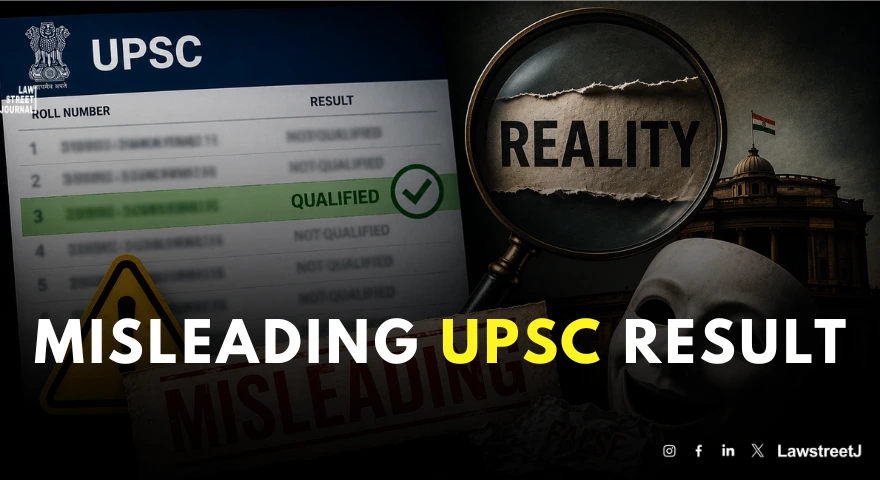
New Delhi: The Central Consumer Protection Authority (CCPA) has imposed a penalty of ₹7,00,000 on Vajiram and Ravi IAS Study Centre LLP for publishing misleading advertisements on its official website in connection with the UPSC Civil Services Examination (CSE) 2023 results.
The Authority found that the institute made sweeping claims about its students’ performance while deliberately withholding material information about the specific nature of the courses those students had actually enrolled in.
The impugned advertisements, published on the institute’s website shortly after the UPSC CSE 2023 result was declared, prominently featured the names and photographs of top-ranked candidates alongside claims such as “8 Rank Holders in the Top 10 are from Vajiram & Ravi,” “37 Rank Holders in the Top 50 are from Vajiram & Ravi,” and “Every year, more than 30% of the officers selected through UPSC Civil Services Examination are students of Vajiram & Ravi.” These claims appeared on the same platform on which the institute simultaneously advertised its full-length paid coaching programmes.
The matter was taken up suo motu by the CCPA. During the course of the preliminary inquiry and subsequent detailed investigation by the Director General (Investigation), it emerged that the institute’s claims rested substantially on students who had enrolled only in its Interview Guidance Programme (IGP), a short-duration programme offered free of charge and available exclusively to candidates who had already independently cleared both the Preliminary and Mains stages of the UPSC examination.
Out of the 413 successful candidates, the institute claimed as its students for UPSC CSE 2023, 258 had enrolled solely in the IGP. Similarly, of the 8 top-ten rank holders cited in the advertisement, 7 had enrolled only in the IGP, and of the 37 top-fifty rank holders cited, 29 had enrolled only in that programme.
The institute contended that any person who avails any service offered by it at any stage of the examination is its student, and that the IGP itself is a comprehensive 3–4 month programme involving mentoring, mock interviews by retired bureaucrats, and DAF guidance. It further submitted that the information in question was not false, that its newspaper advertisements did disclose course-specific details, that enrolment figures remained stable around the relevant period indicating no exceptional gain from the advertisement, and that the advertisement had been removed promptly upon receipt of the CCPA’s notice.
The CCPA rejected these submissions. It observed that the duty to ensure truthful and complete disclosure in advertisements rests squarely on the service provider, and that consumer protection standards cannot be diluted merely because the target audience comprises highly educated individuals.
The Authority noted that the doctrine of caveat emptor has evolved into caveat venditor, placing greater obligations on sellers and service providers to ensure accurate representation. Crucially, it found that the institute had disclosed course-specific details in its newspaper advertisements but consciously chose not to do so on its official website, which has a far wider and more persistent reach. This selective omission was held to reflect a deliberate and calculated decision to withhold material information from the very platform where prospective aspirants research and make enrolment decisions.
The CCPA emphasised that candidates who enrolled only in the free IGP had already cleared two rigorous stages of the examination entirely on their own merit, without any academic contribution from the institute at those stages. By displaying their photographs and ranks alongside advertisements for full-length paid programmes, without disclosing the specific course availed, the institute created the misleading impression that these candidates had been comprehensively trained by it across all stages of preparation.
The Authority also noted that this practice is not unique to the institute, observing that multiple coaching institutions use the names and photographs of the same successful candidates in their promotional materials while concealing course details, making it virtually impossible for consumers to independently verify the nature of any candidate’s association with a particular institute.
The CCPA held that the institute’s conduct constitutes a misleading advertisement under Section 2(28)(iv) of the Consumer Protection Act, 2019, namely, the deliberate concealment of material information, and amounts to a violation of consumers’ right to be informed under Section 2(9) of the Act. It further held that the conduct is contrary to paragraphs 4 and 12 of the Guidelines for Prevention of Misleading Advertisements and Endorsements for Misleading Advertisements, 2022.
In exercise of its powers under Sections 20 and 21 read with Sections 10 and 19 of the Act, the CCPA directed the institute to ensure that all future advertisements comply with the Consumer Protection Act, 2019 and the rules, regulations, and guidelines framed thereunder, to pay a penalty of ₹7,00,000 and submit a compliance report within 15 days of receipt of the order.
Case Title: CCPA v. Vajiram and Ravi IAS Study Centre LLP, Case No. CCPA-2/24/2024-CCPA



![SC Orders UPSC to Allow Scribe Change 7 Days Before Exam, Mandates Screen Reader Plan for Visually Impaired Candidates [Read Judgment]](/secure/uploads/2025/12/lj_7553_SC_Orders_UPSC_to_Allow.webp)